
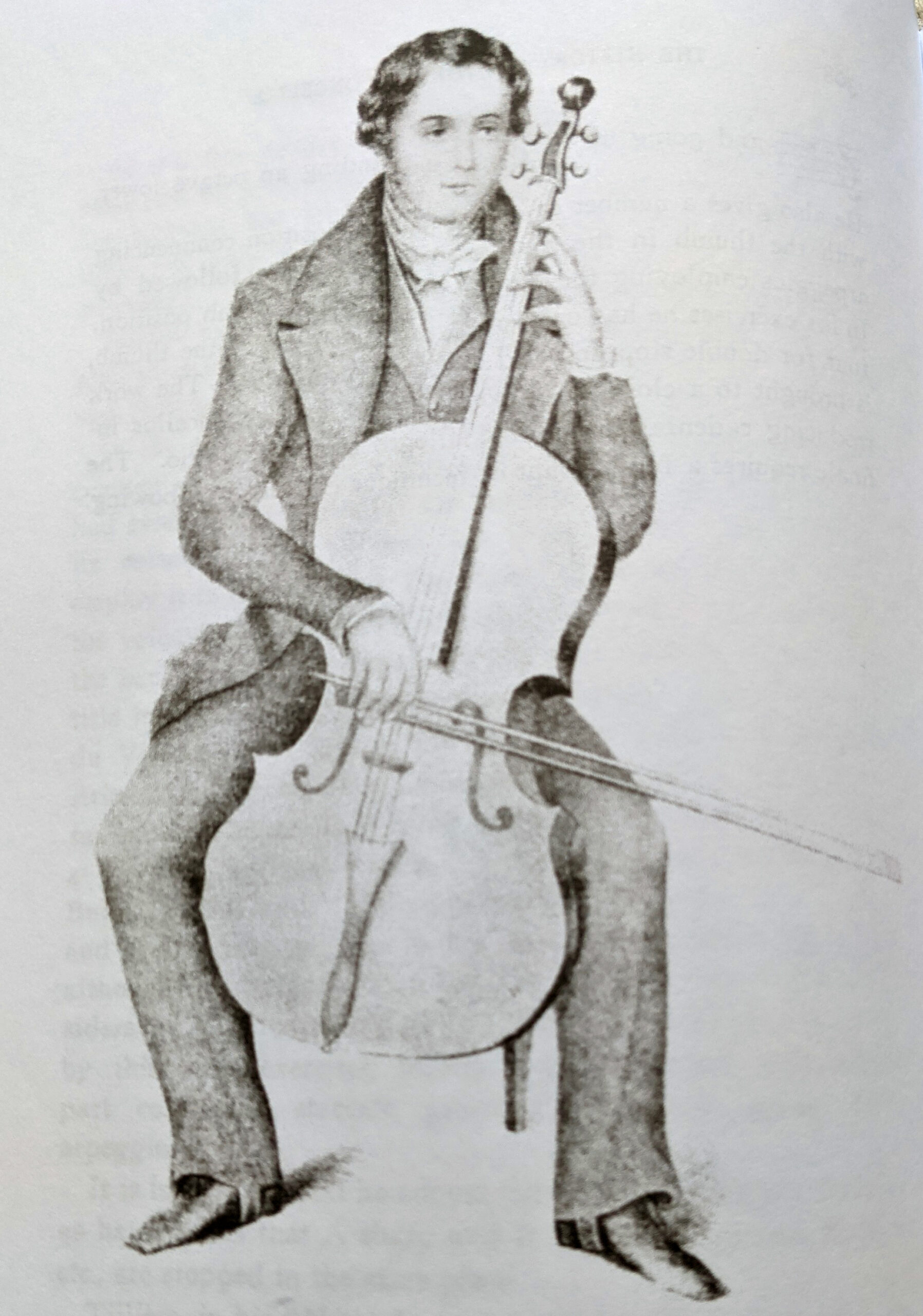
Sebastian Lee (1805–1887)
Do you love Lee? This question will likely be answered only by those amongst this blog’s esteemed readers who have ever held a cello between their knees. For, added to our catalogue at the end of last year was cellist and composer Sebastian Lee (1805–1887), who is famous today only for his pedagogical works. These enjoy, however, an almost unbelievable popularity – be it the Méthode pratique pour le violoncelle, op. 30, published in Paris in 1842 and presently still available, or collections of études such as the 40 Études mélodiques et progressive, op. 31 (HN 1519), composed for the Paris Conservatoire in 1843, which recently enriched our catalogue.
And, as so often with études, preparing the Urtext edition revealed that reconstructing the editorial history of such instructional literature as that canonical for over 100 years but also being repeatedly revised to meet current needs, can definitely lead to surprises. Some time ago in this forum, my colleagues already reported on this, using the example of violin études by Rodolphe Kreutzer and Jakob Dont; and now I was to have the same experience with Sebastian Lee.
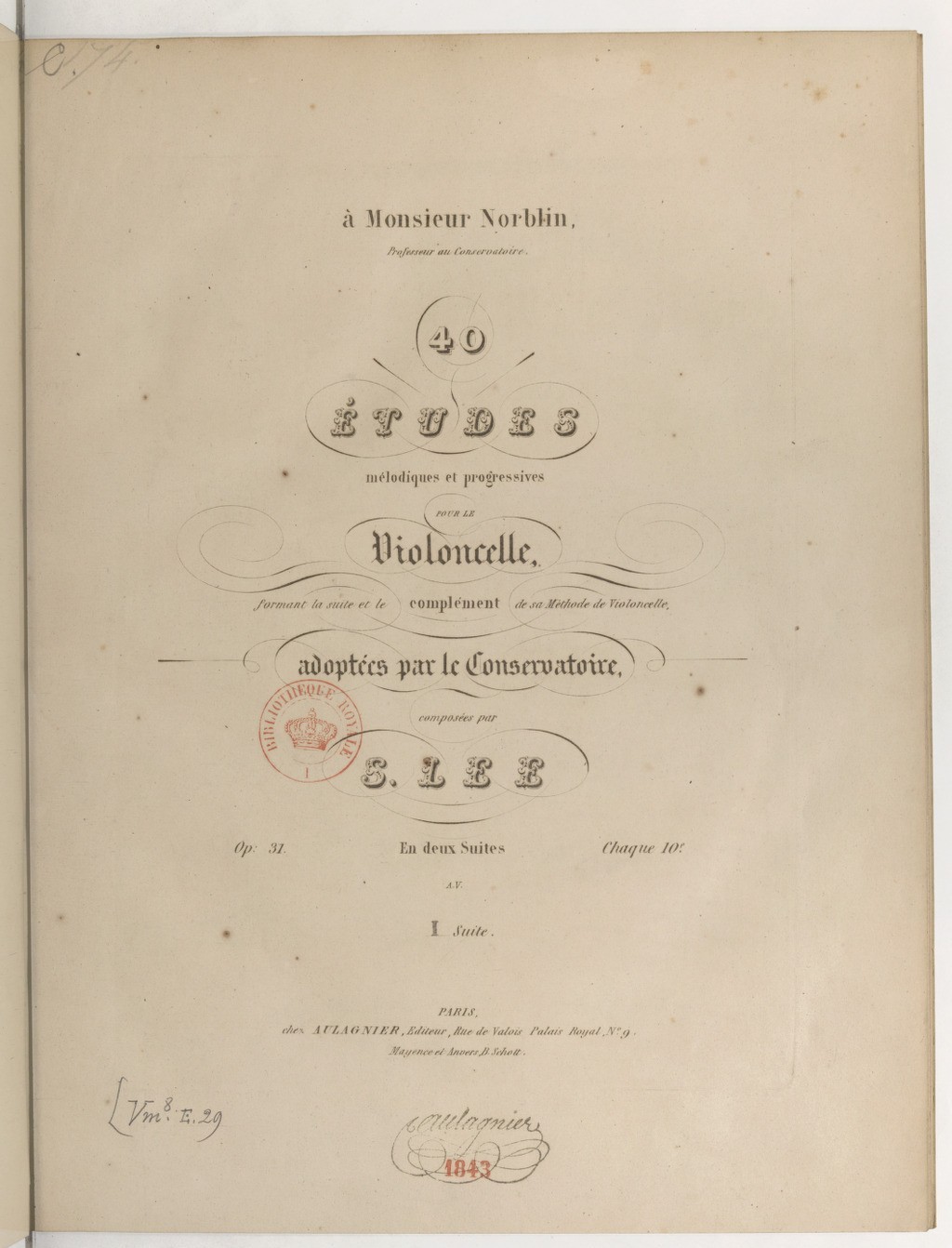
First edition by Aulagnier with entry stamp 1843
At first, everything seemed quite simple: the first edition of Lee’s opus 31, like his Violoncelloschule, op. 30, appeared from the Paris publisher Aulagnier; the exact date, 15 July 1843, could be verified in the Bibliographie de la France and was confirmed by the entry stamp on the copy in the Bibliothèque nationale.
The edition was later taken over by Schott in Mainz, where for a new edition at the beginning of the 20th century, the famous cello teacher Hugo Becker (1864–1941) revised the op. 31 études as part of a collection of Lee’s works. Based on this, numerous publishers over the last 100 years have released further editions, more or less “adapted” for current use by various cellists. All these later editions differed significantly from the first edition, with several pieces – 10 of the 40 works – shortened by entire, 8- or 12-measure sections. For us as an Urtext publishing house, the matter seemed clear: the 1843 first edition would be the main source for an edition presenting the full text as written by the composer, free of cuts and changes made by later editors such as Hugo Becker – or maybe not?
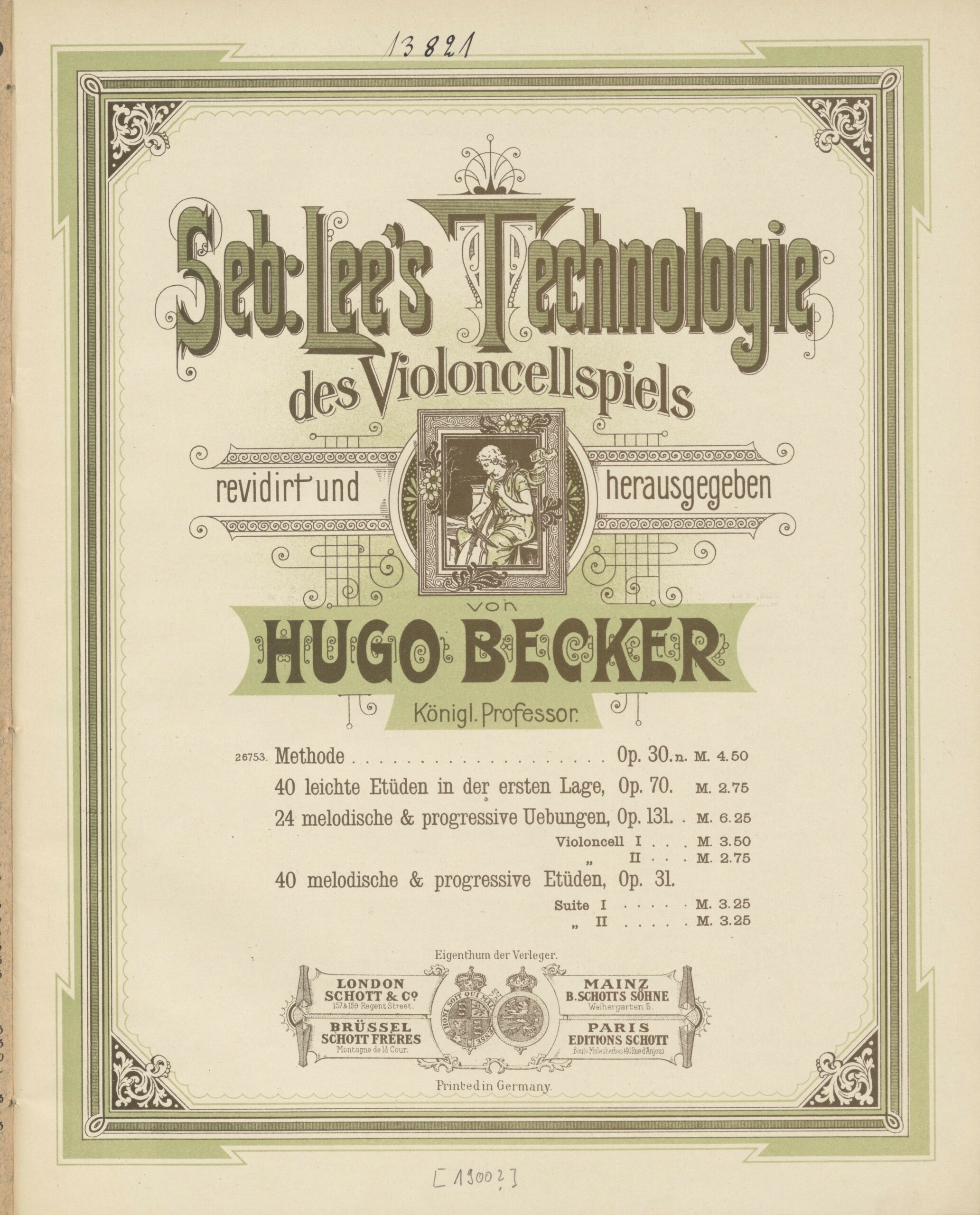
Revised edition by Hugo Becker printed by Schott in 1901
That an editor would shorten a collection of études was, after all, rather odd. Normally, later editors of études tend to add to the original (see my colleagues’ blogposts mentioned above!) – whether by fingerings and bowings or by information on dynamics, articulation and tempo. Moreover, Hofmeisters Monatsbericht for March 1853 contained an entry by Schott publishing house, announcing an edition of the études, op. 31.
So, published ten years after the first French edition, whilst Lee was still alive, was another German edition of the études, presumably a simple reprint of Aulagnier’s edition. But, of course, we set out to find a copy – especially since good advice was so close at hand: for several years now, the Bavarian State Library in Munich has housed part of Schott’s historical archives; the publishing house’s entire holdings were gradually to be made available online as part of a large-scale digitization project.

Entry in Hofmeisters Monatsbericht for March 1853
Although the Schottarchive-digital was not yet publicly accessible, upon my enquiry about the op. 31 études, I was told that the Schott edition with the new plate number could be identified in the publishing house’s printing book, but that no physical exemplar was available. Extant instead was an Aulagnier edition that had apparently served as the engraver’s copy for the Schott edition and contained numerous handwritten entries. This was, of course, all the more intriguing!
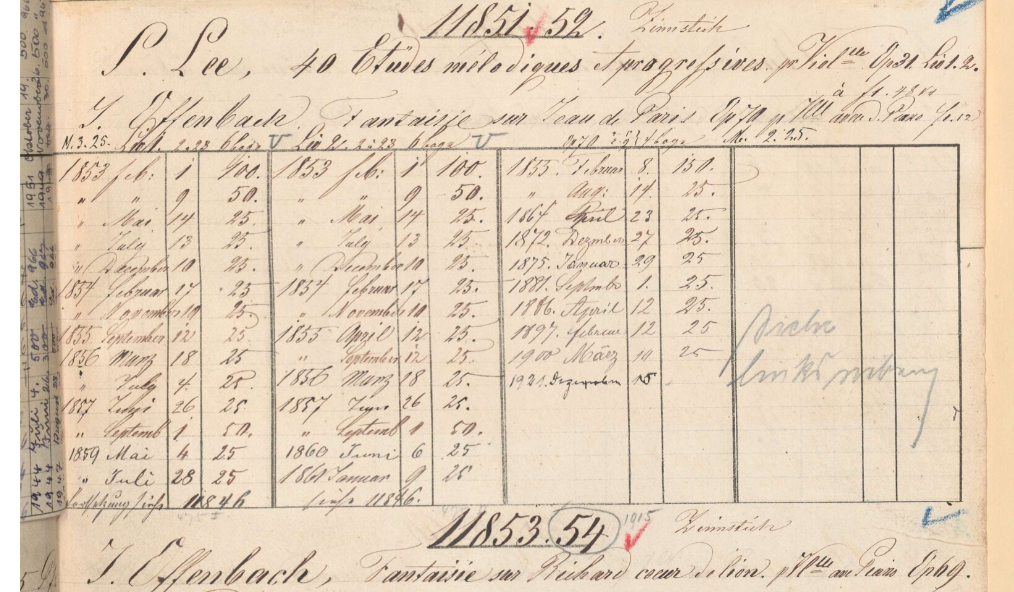
Schott’s printing book, entry for plate no. 11851/52
So, whilst our editorial assistant tirelessly continued searching for the German Schott edition (and also finally found one in the Frankfurt University Library!), I made my way to the Bavarian State Library, where I was kindly permitted to view the engraver’s copy, then being prepared for digitization. It turned out that the handwritten entries in the print also included the cuts previously known only from Becker’s later new edition and that had always been attributed to him. Meantime, scans of the 1853 Schott edition had arrived from Frankfurt, confirming that these changes had already appeared in print in 1853 – and thus, could in no way be attributed to Hugo Becker, who was not born until a decade later.
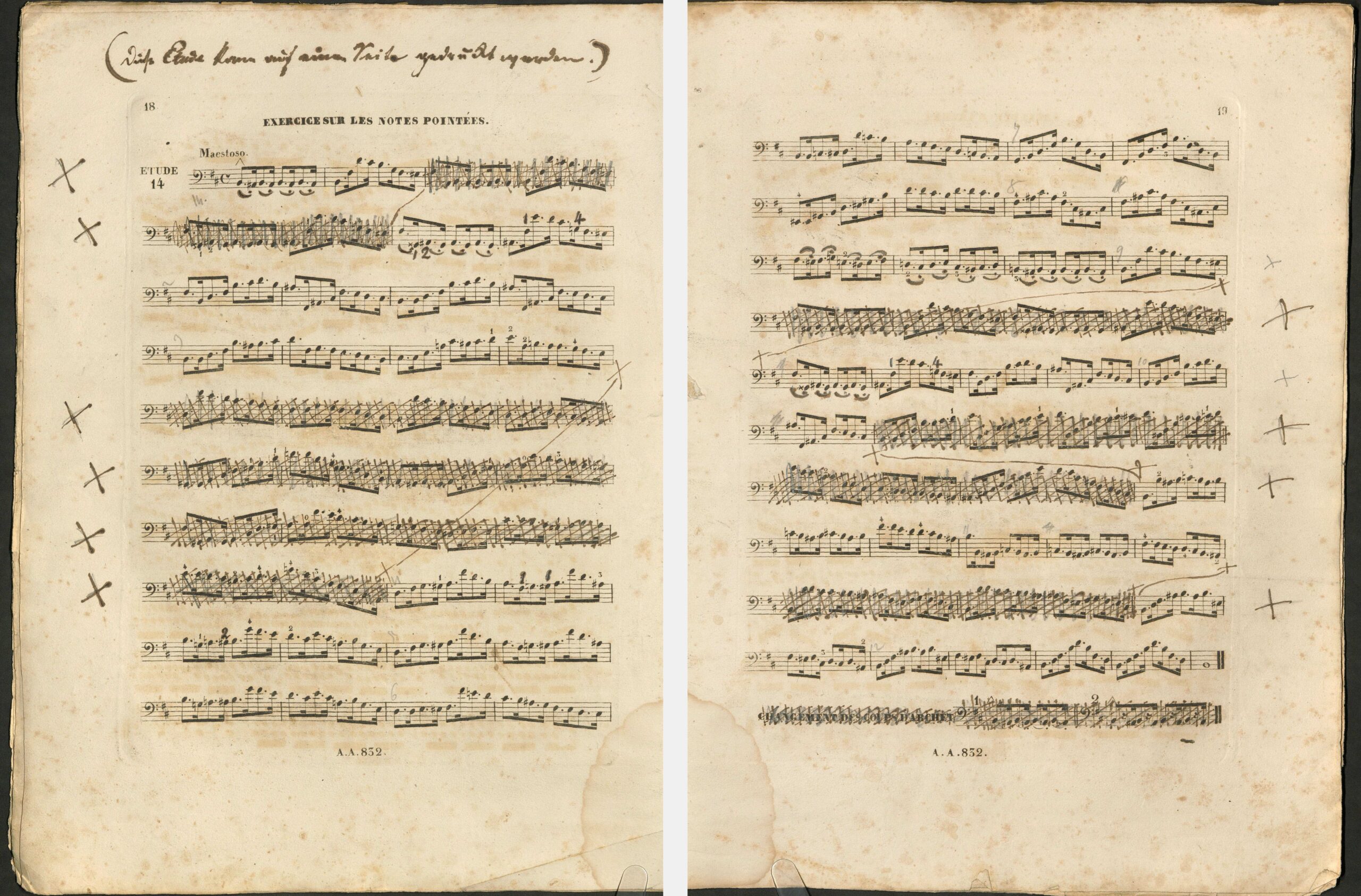
No. 14 of engraver’s copy with handwritten note
Rather, more likely is that the Schott re-engraving was accompanied by a revision of the music text by the composer himself. This may have been primarily motivated by the (publisher’s) desire to reduce the work’s length – as suggested by the explicit note “This etude can be printed on one page” in the case of the particularly heavily cut No. 14, previously occupying two pages – though changes to articulation and figuration in other places also involving purely musically-motivated alterations that would not have been “necessary” from the publisher’s perspective, more likely point towards the composer.
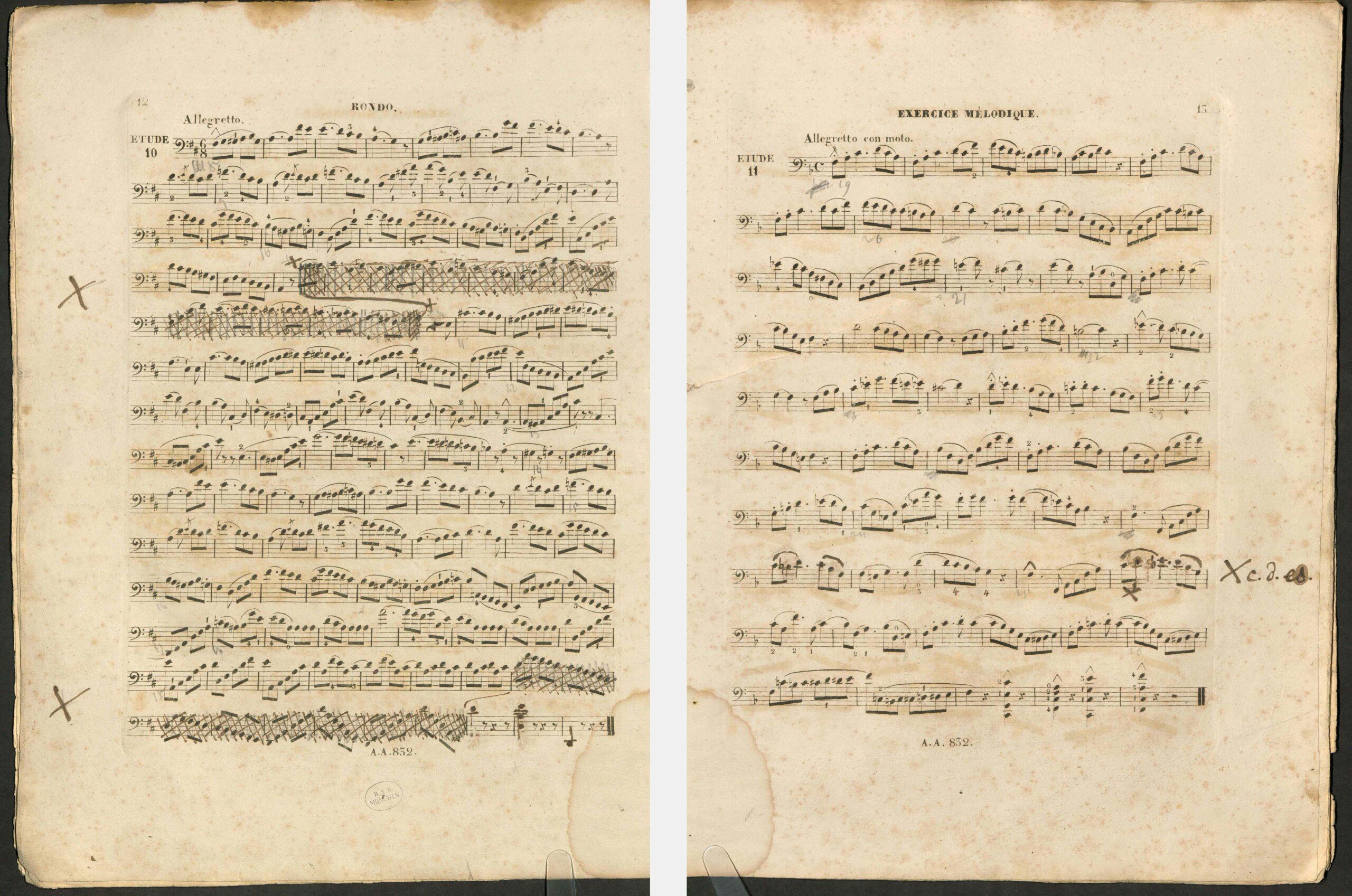
Nos 10 and 11 of engraver’s copy
For example, the cutting of two sections, of, respectively, 12 and 8 measures in No. 10 can be explained by the desire to present Nos. 9–11 in the German edition on two pages instead of the previous three. The change in figuration in two measures of No. 11, on the other hand, executed by erasure in the engraver’s model and further clarified by marginal pitch letters, is purely melodic in nature.
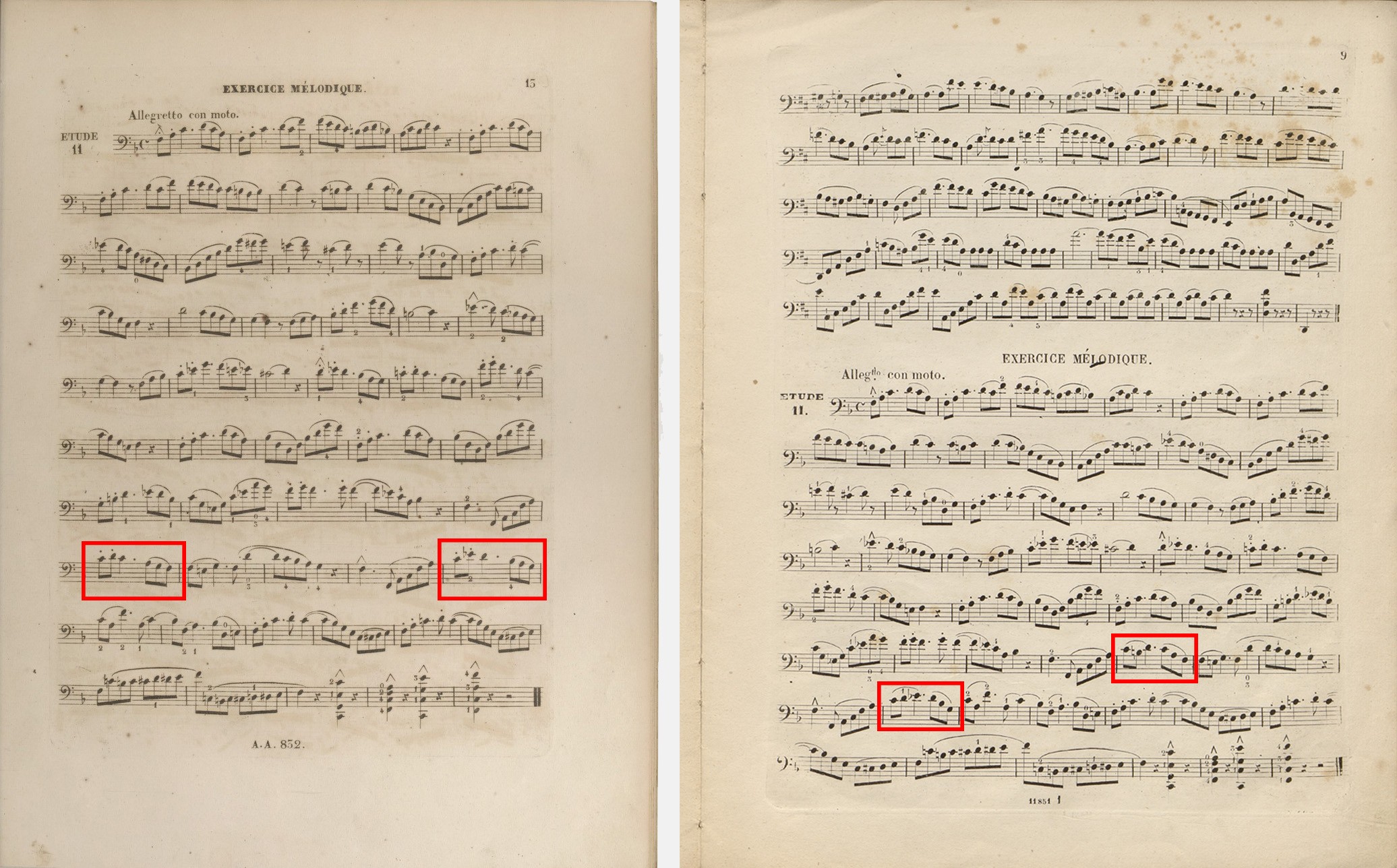
left: first edition by Aulagnier, no. 11,
right: revised edition by Schott, no. 11,
highlighted mm. 38, 42
Lee’s authorship of these changes cannot yet be proven: the handwriting of the entries cannot be verified beyond doubt, and the revision is not documented by secondary evidence or by relevant references in the printing book or on the edition’s title page. The use of two writing instruments (pencil and ink), however, and the nature of the alterations suggest that the publisher first pencilled a new score-engraving layout (indicated by the small numbers in the music text), together with suggestions for possible cuts; these were then confirmed or implemented in ink by another scribe, who made further changes – and who else but the composer could this have been?
Based on these considerations, it was now clear that the primary source for our Urtext edition was not to be the French first edition of 1843, but rather the revised German edition of 1853. And that this Urtext edition consequently presents later cuts and changes familiar to us from the Becker edition – though, contrary to previous claims, not originating with Becker. In fact, a comparison of Becker’s new edition with the 1853 Schott edition shows that aside from sparingly adding dynamics (almost completely absent from the 1843 and 1853 editions), Hugo Becker limited himself to a few minor changes in bowing, fingering, and phrasing – thus treating the original music text with considerably more care than many of his contemporaries.
To return in closing to the question posed at the start: Anyone who has ever played a Lee étude will wholeheartedly answer “yes”, because their combination of catchy melodies and effective training makes practicing a joy and trains not only finger dexterity but also a sense of musical interpretation – and this is also to be hoped for with our edition, which, incidentally, was also edited by a renowned cello pedagogue: Wolfgang Emanuel Schmidt has provided the music score with practical notes on the objectives of the études and, where necessary, contributed additions and alternatives to the historical fingering. Naturally, these additions are indicated by grey print – as is usual in our étude editions. So that, at least from now on, it will be clear once and for all what is by the composer – and what is not!