
Whilst this year the classical music world is undoubtedly focussed on Maurice Ravel’s 150th birthday, another French composer’s anniversary should not be completely forgotten: Erik Satie’s 100th anniversary of death on 1 July 2025. And what could be more natural than to take a closer look at the relationship between the two? For although Satie was a complete musical outsider in his day, he had many contacts with important musicians and composers in fin-de-siècle and Belle Époque Paris, including, amongst others, not only Ravel, but also Claude Debussy, Albert Roussel, Igor Stravinsky and Ricardo Viñes.
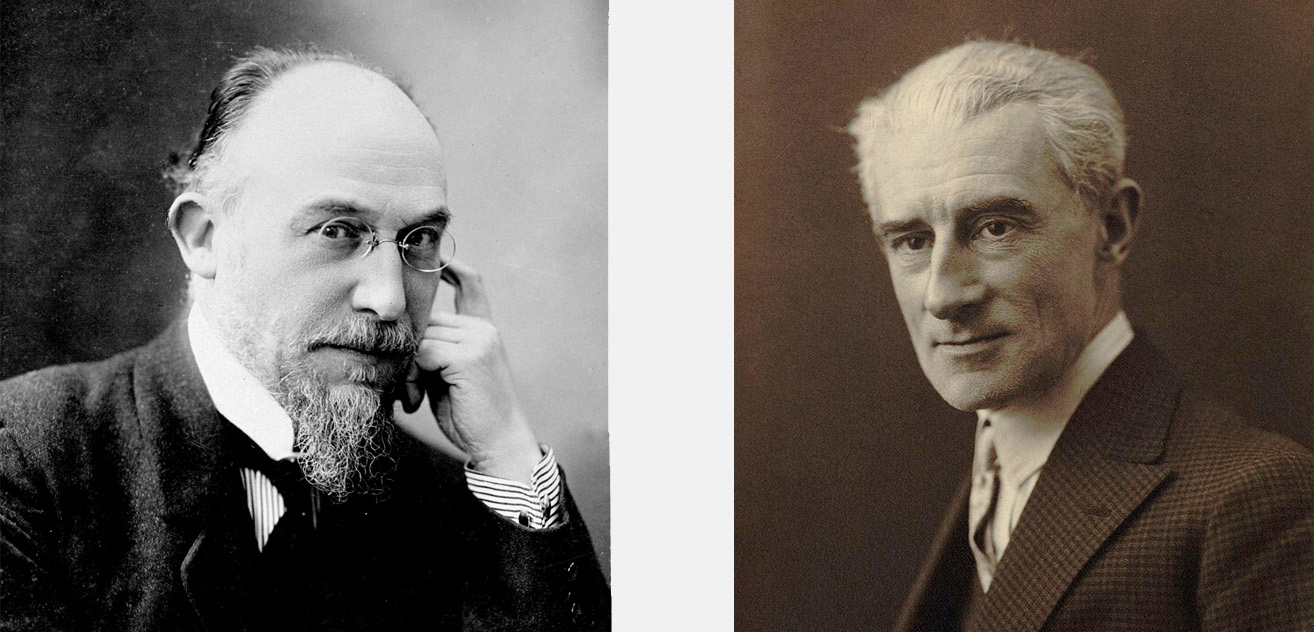
left: Erik Satie (1866–1925), right: Maurice Ravel (1875–1937)
Satie and Ravel met in 1892 or 1893 in one of the numerous cabaret cafés in the Parisian artists’ and entertainment districts of Montmartre and Pigalle, presumably at the Café de la Nouvelle Athènes on Place Pigalle. In any case, they were not living far apart at the time, with the Ravel family residing on Rue Pigalle and Satie on Rue Cortot, only about 900 metres away. The encounter was arranged by Ravel’s father, who had acquaintances in common with Satie – artists, especially painters frequenting this café. In such establishments, Satie accompanied singers on the piano or performed his own compositions, characterised by their static and archaic nature in an odd neo-Greek or neo-Gothic manner. The young Ravel was apparently immediately taken with a style completely out of step with the times. This was then certainly helped by the fact that both composers were enthusiastic about Emmanuel Chabrier’s music, particularly its bizarre, quirky and ironic features. With therefore plenty of common points of contact, Ravel’s great liking of the man nine years his senior may also ultimately have been influenced by Satie’s abundant humorous vagaries in his personal interactions, as is also evident in his writings and letters.
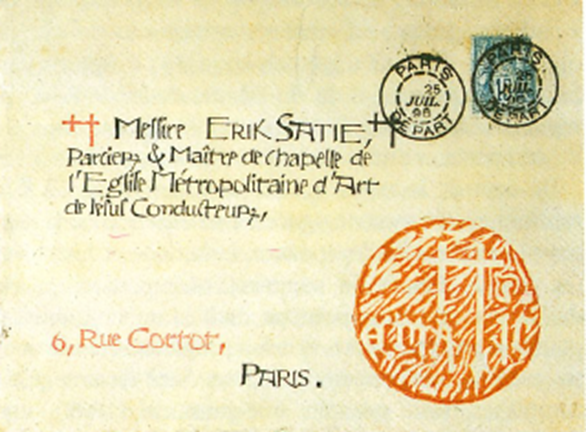
One of Satie’s bizarre ideas was to address letters to himself; in 1893, he founded the ‘Eglise Métropolitaine d’Art de Jésus Conducteur’ (Metropolitan Church of the Art of Jesus our Conductor), of which he was the sole member.
Satie’s influence particularly appears in Ravel’s early chansons. The younger composer, who was always very open and honest about his inspiration, stated in his Esquisse autobiographique [autobiographical sketch] dictated in 1928: “My first compositions date from around 1893. The influence of Emmanuel Chabrier was evident in the Sérénade grotesque for piano; that of Satie in the Ballade de la reine morte d’aimer.” Striking features of the chanson (translation: Ballad of the Queen Who Died of Love) are its simple structure and melody, as well as its archaic tone in using the Dorian mode (instead of the ♭-sign (b-flat) for D minor, ♮ (b-natural) is used for Dorian D). But Satie also left his mark on Ravel’s piano works, in, for example, the dissonances caused by “false” root notes, such as at the beginning of the Pavane (model: Gymnopédies) or in unresolved seventh or ninth chords in Jeux d’eau (model: Sarabandes).
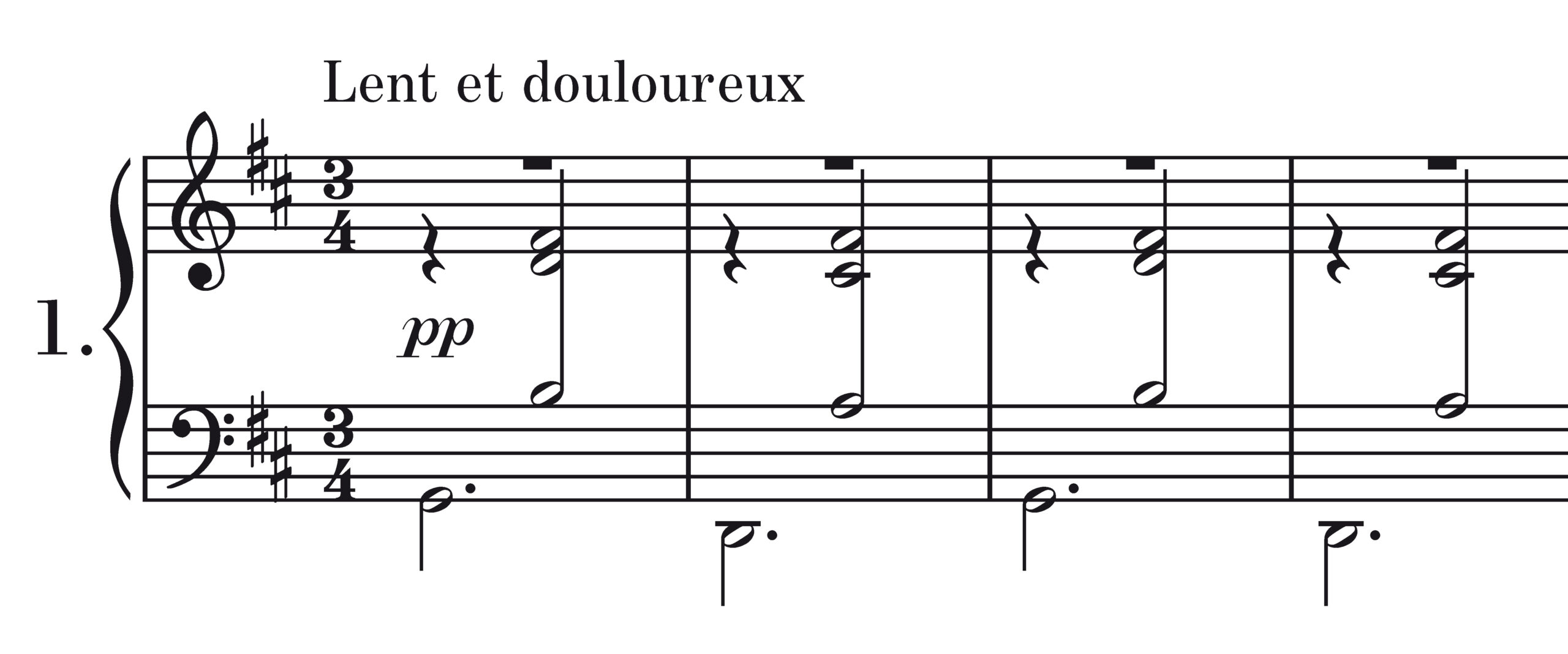
Satie, Gymnopédie No. 1
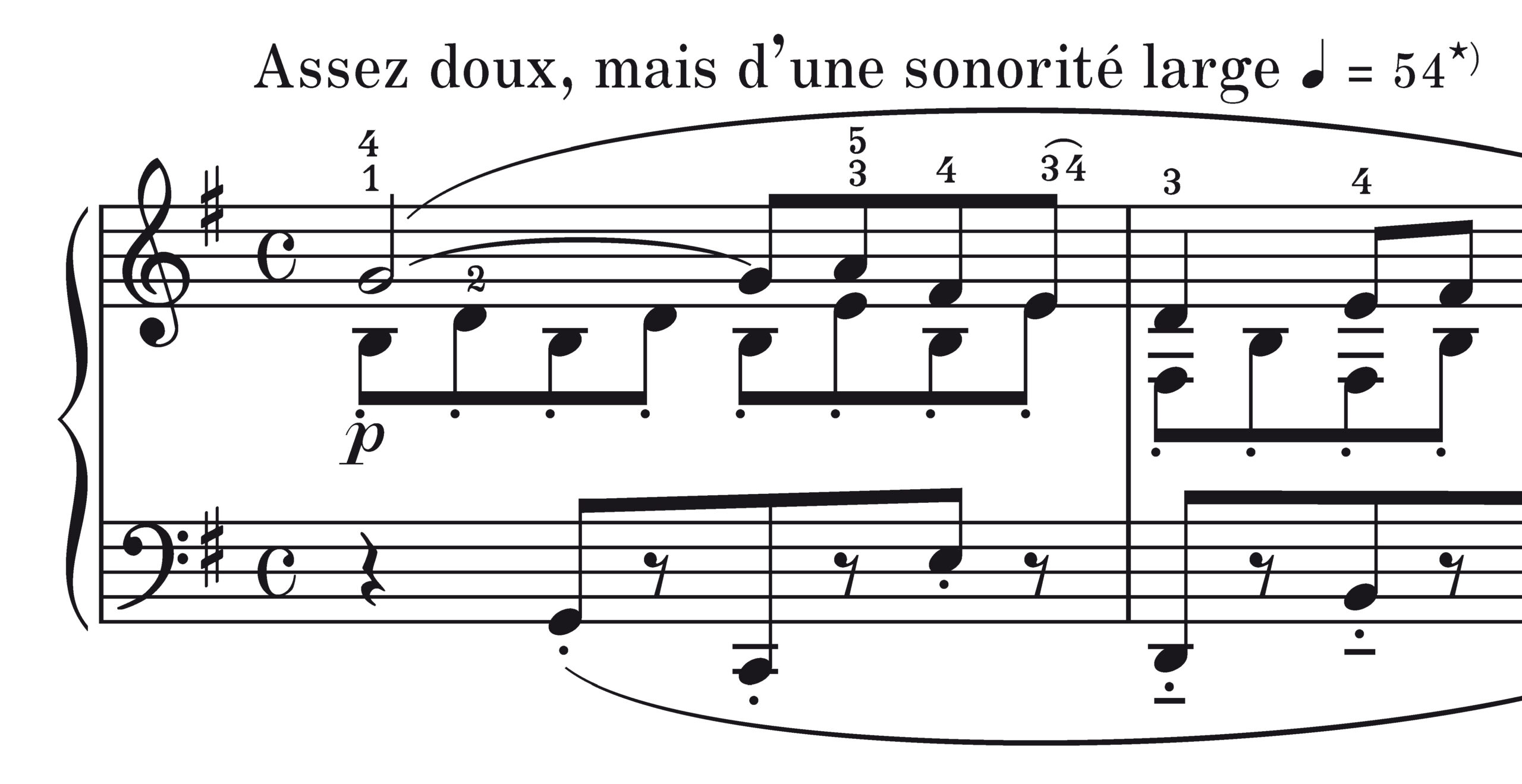
Ravel, Pavane pour une infante défunte
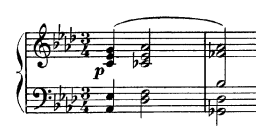
Satie, Sarabande No. 1
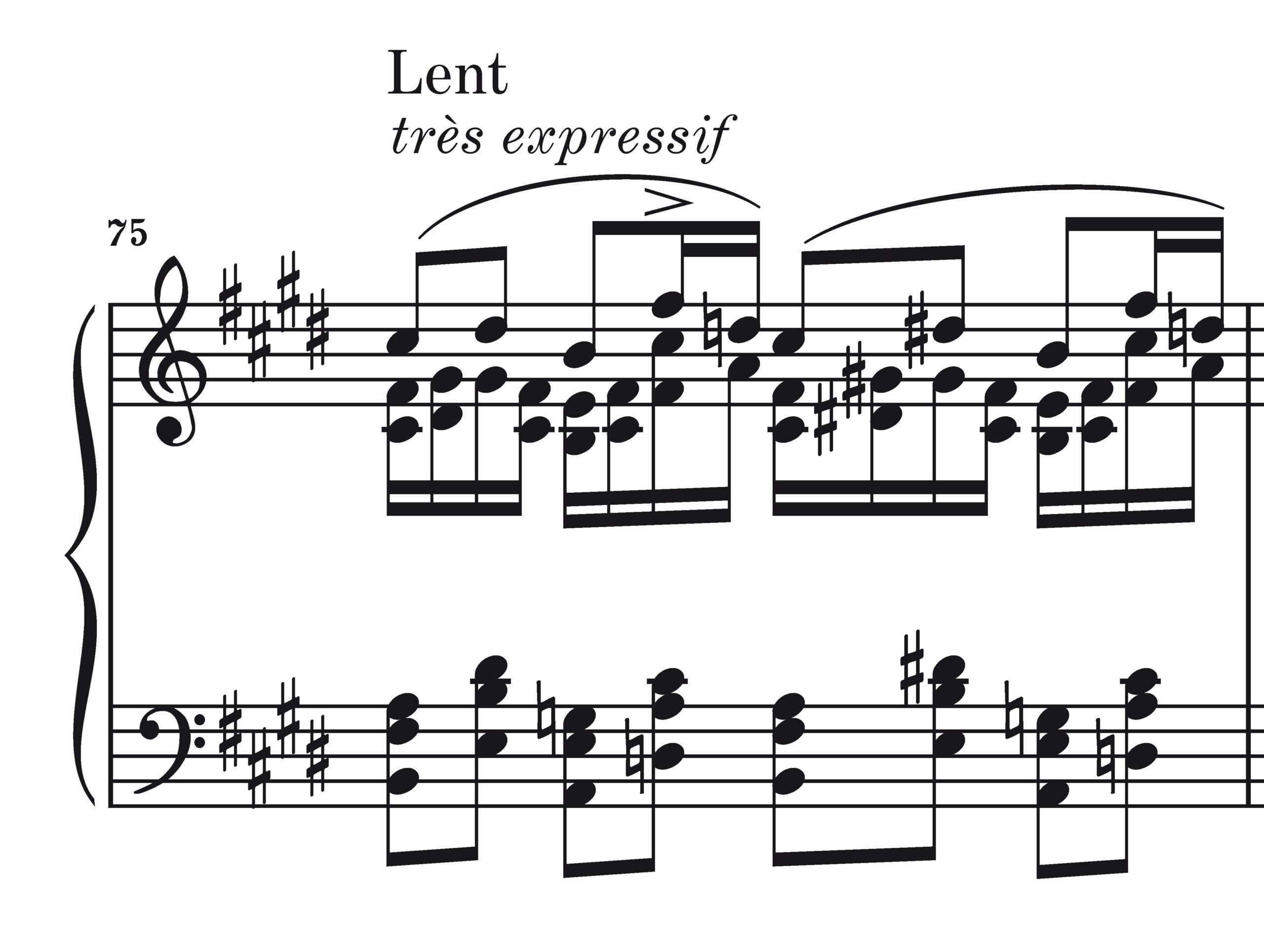
Ravel, Jeux d’eau
Such similarities, however, should not obscure the fundamental difference between the two composers’ styles and compositional techniques. Satie’s compositions are very simple and static, often meditative in nature, whereas Ravel’s are complex and dynamic, frequently of a highly virtuosic cut.
After their initial encounters, the two composers went their separate ways until around 1910 when Ravel endeavoured to have Satie rediscovered within Parisian musical life (which for many music lovers was essentially a first discovery). The background to this was the “Société musicale indépendante”, co-founded by Ravel, which competed with the long-established “Société nationale de musique”, now considered academic and ossified. In his search for new names and, especially, neglected talents of the French avant-garde, he came to Satie at just the right time. He organised a concert on 16 January 1911, playing three Satie works, the third Gymnopédie, the second Sarabande and the Prélude du Fils des Étoiles. In the programme booklet’s section presumably written by Ravel, Satie was presented as “the brilliant pioneer” who “a quarter of a century ago spoke the bold musical language of tomorrow”. Satie was flattered by so much attention, though also annoyed, as he was not accustomed to it, confessing to his brother on the occasion of this concert: “Ravel is a Rome Prize winner [actually not true] of great talent. A Debussy, only more astonishing. He affirms to me – every time I meet him – that he owes me a lot. That’s fine by me.” And a few months later: “Ravel occupies an important position in modern music. I knew him when he was still a child [although Ravel was already 17 or 18 when they first met] and have always been interested in his work.”
The first dark shadows on the relationship were cast by, of all things, a dedication. In 1913, Ravel dedicated to him Surgi de la croupe et du bond, the third of his Mallarmé settings. At first glance, this may appear to be a counterpart to Satie’s dedication of his second Sarabande to Ravel, but Satie took the choice of text personally – a hermetic poem with manifold associations evoked by the sight of an empty vase –, as an allusion to his own “emptiness”, to his inadequacy due to his insufficient musical education. This was certainly not Ravel’s intention, but Satie’s friendships often broke down owing to insinuations or deliberate misunderstandings. This was also the case here, as he took revenge in a very unpleasant way: with the three Valses distinguées du précieux dégoûté (Distinguished Waltzes on Affected Disgust), intended to characterise a typical dandy, namely Ravel. By this time, Satie’s sympathy for Ravel had completely changed, as the latter had volunteered for military service at the 1914 outbreak of World War I, which Satie, as a socialist and pacifist, found incomprehensible. The first of these waltzes is entitled “Sa taille”, referring here to the figure of the dandy, but also having the secondary connotation of “height”, alluding to Ravel’s strikingly short stature. To ensure that everyone in the music scene understood the allusion, he dedicated the piece to Roland-Manuel, whom he had introduced to Ravel in 1911 and who had been closely associated with him ever since.
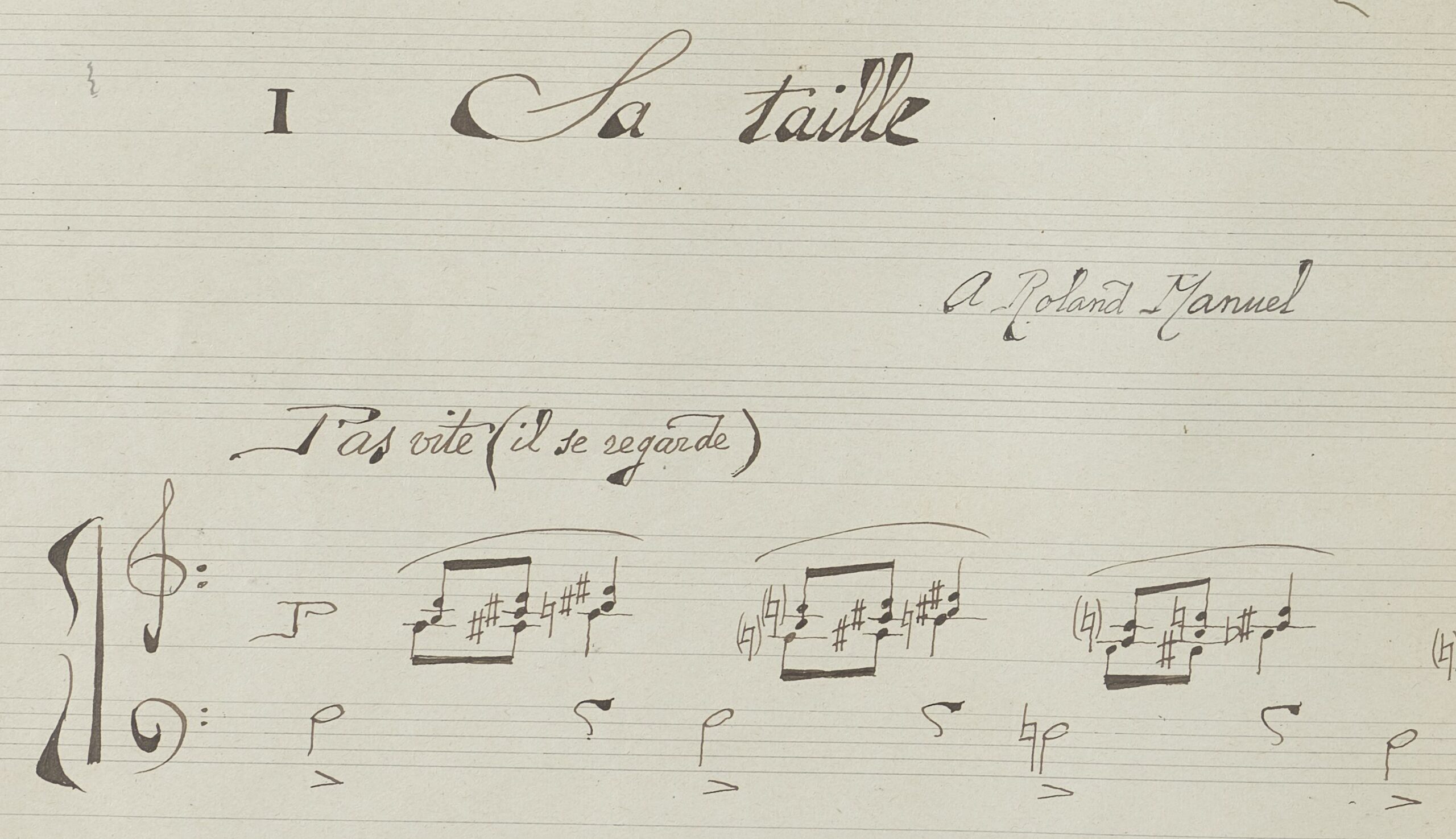
Erik Satie, opening of the first of the Valses distinguées du précieux dégoûté (Paris, Bibliothèque nationale de France)
But when the waltzes were published in 1916, Ravel was anything but offended. In a letter to Roland-Manuel in 1918, he wrote: “My incurable pride prevents me from fearing anything, and I bear no ill will towards this big child, who may be a Norman, but is nonetheless a big child.” Ravel did not even have to mention Satie by name, because “Norman” could only refer to Satie, who was born in Honfleur, Normandy, in 1866. Even after his death, Ravel continued to praise his role in contemporary French music, undeterred by personal attacks: “Satie possessed an extremely sharp intelligence, the intelligence of invention par excellence. […] Satie showed the way, but as soon as another musician took the path he had found, Satie immediately changed his own direction and then, without hesitation, opened up a new path to new fields of experience.”
The relationship between Satie and Ravel shows once again how unevenly – distance on the one hand, admiration on the other – former friendships can develop over time.