
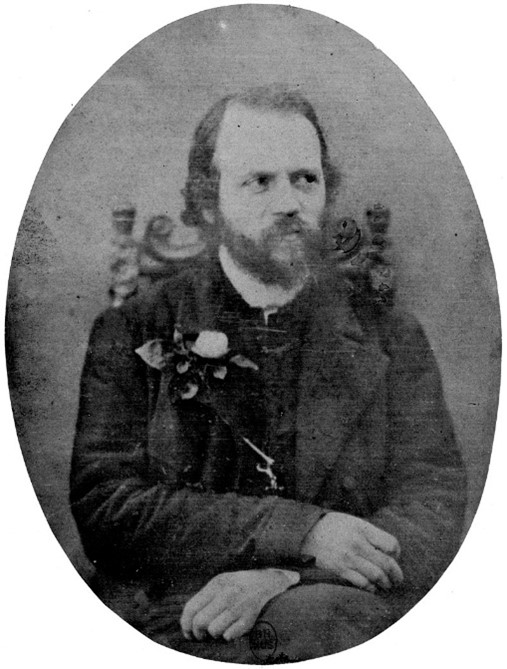
Charles -Valentin Alkan, ca. 1865 (photo of unknown origin, Bibliothèque nationale de France, Paris)
“Alkan? Lots of notes!” – That’s what you hear when mentioning that you’ve edited the Symphonie for piano by French composer Charles Valentin Alkan (1813–1888) for Henle: HN 1657. And “lots of notes”, coupled with the expert French pronunciation of “Alkan”, is all that many music professionals know about this composer, myself included until recently. This is not surprising, considering how much Alkan shunned publicity, though in no way does it reflect the increasing importance (documented in a growing number of recordings) that his music is accorded by those studying 19th-century piano virtuosity or even capable of playing the works. Beyond question, this requires pianistically masterful hands. Three are ideal. The great pianist Marc-André Hamelin is, for example, one of those terrific Alkan interpreters who have three hands.
There were times when Alkan was considered one of the most important piano wizards. Franz Liszt was downright intimidated by Alkan’s piano playing, and that’s saying something. When Ferruccio Busoni once listed those he considered the most important piano composers after Beethoven, he named Liszt, Chopin, Schumann, Brahms and – Alkan. So, he must therefore be a Henle composer of the highest order, reigning supreme, if not for Isaac Albéniz and Tomaso Albinoni, in the alphabetical catalogue.
As Wolfgang Rathert explains in his preface to our Symphonie edition, Alkan’s Douze Études dans tous les tons mineurs, op. 39, also stands at the pinnacle of what the étude genre achieved in the 19th century. The Symphonie comes from this collection of études; the work’s title should thus not be taken to suggest a classical orchestral symphony. In opus 39, Alkan composed twelve piano études, one in each of the minor keys, following a key signature plan with an increasing number of flats, an enharmonic hinge and a decreasing number of sharps. Hitting you in the face upon opening the Symphonie edition are its curiosities. Babylonian chord towers, serpentine garlands of ties and legato slurs, in some places swarms of double sharps clearly indicating that the measures in question are at a decided distance from the actual key signature.
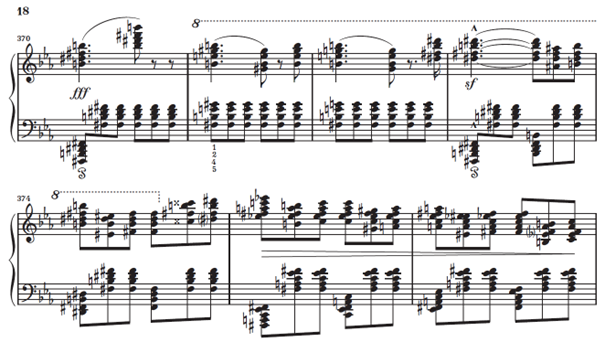
Symphonie, 1st mvt.: Evidence of mid-19th-century chordal tower-building, Henle-Urtext
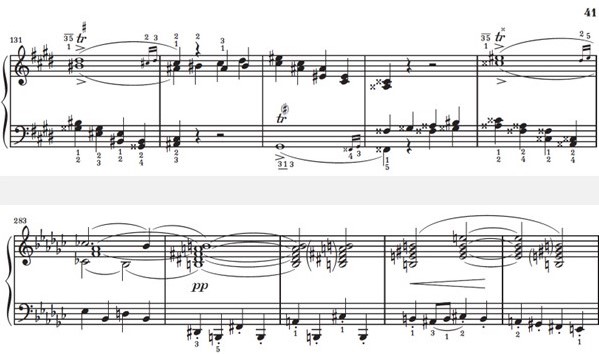
Symphonie, 4th mvt.: More accidentals and ties/slurs could hardly be notated, Henle-Urtext
Even the seemingly friendly minuet becomes a veritable witches’ dance owing to its ruthless tempo. Part of their special aura is that Alkan sometimes gave his op. 39 études descriptive names and grouped several of them together. Our Symphonie consists of études nos. 4–7, followed by a concerto that also comprises four études. Finally, Étude no. 12, Le Festin d’Ésope, has long been available in Henle Urtext as HN 1394.
Although eccentric geniuses are so highly valued in music history, Alkan was virtually forgotten, certainly also partly due to the fact that the deeply devout Jew withdrew for years into private life to translate the Bible and study the Talmud, rarely appearing in public where others were effectively marketing their music.
All the more reason for Alkan’s artistry to be rediscovered today. The Symphonie is still usually printed as a reproduction of the 1857 first edition. Our edition now gives it Henle Urtext quality. The modern, dense yet uncluttered musical notation preserves important features of the original while freeing it of unnecessary symbol clusters and oddities that are now rather confusing. And although there are only a few errors in the first edition thanks to Alkan’s pedantry, a number of problematic passages have been clarified.
As with Le Festin d’Ésope, the fingering was provided by the superb pianist and Alkan specialist Vincenzo Maltempo. For me, trying his fingering out myself in the manuscript stage was an experience. Among other things I asked Maltempo whether he really wanted to play a fairly large interval with the 5th and 2nd fingers in a tricky passage. Yes, of course. Though he had a precise musical derivation for this, he said that above all it was still an étude, “so it would be an opportunity to improve legato and finger stretching”. To me, as a mere mortal pianist, that sounded pretty amusing, because according to this logic, climbing an eight-thousand-metre mountain would be a nice opportunity to practise holding on to overhanging rock faces. But Maltempo is, of course, correct in his virtuoso thinking, because anyone who plays Alkan is moving within the highest regions of piano artistry.