
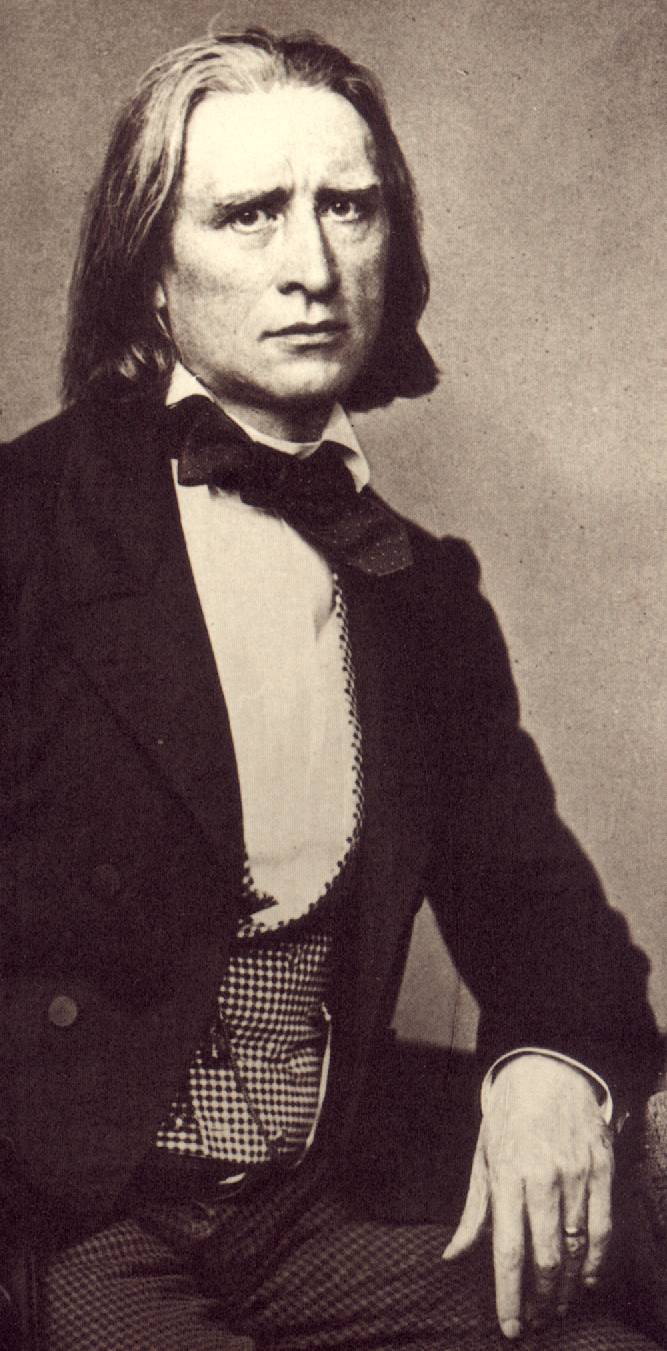
 The Weimar years as of 1848 marked a profound turning point in Liszt’s life. This was owing, on the one hand, to his decision to live with Princess Carolyne von Sayn-Wittgenstein, whom he had met in Kiev in 1847, and who subsequently exerted a great influence on him; on the other hand, to his abandoning of his career as a piano virtuoso and focussing on composing alongside his official duties as “extraordinary kapellmeister”. Encouraged by his experiences as a conductor, he devoted himself to composing in such new genres as the symphonic poem, but also to revising an array of works, both already published or even still unpublished.
Although usually Liszt quite quickly committed to paper his ideas for new works, he typically set aside these first drafts, subjecting them only later to more or less extensive revision. Extant of numerous works are, as a result, two or more versions. He had many of them published, representing – in hindsight – only a first, not yet definitive stage in the compositional process. As an example, the Hungarian Rhapsody No. 2 vividly demonstrates that even works considered complete were subjected to further review and slightly altered whenever an opportunity arose – in this case, the publisher Ricordi’s request for permission to publish an Italian edition (cf. comments in HN 1586). Since Liszt’s publishers were far from enthusiastic about such continual revisions, Liszt apologised in 1863 to one of them for his “obsession with improvement”, which had become a “chronic, incurable affliction”.
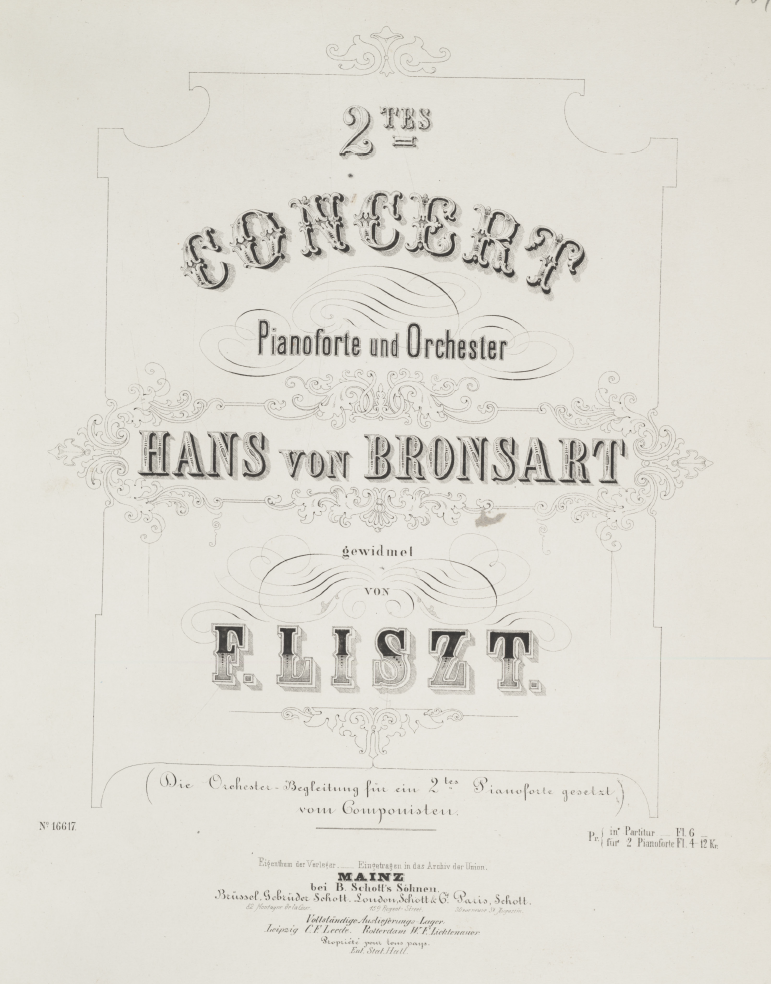
Joint title page of the first editions of the piano reduction (1862) and the full score (1863)
Amongst the compositions with a longer genesis history in several versions are the two well-known piano concertos in E-flat major and A major. When I undertook the task of editing a new critical piano-reduction edition of the 2nd Concerto in A major, I was initially overwhelmed, even quite stunned, by the wealth of sources. But the more intensively I dealt with them, the clearer the classification and assignment of the sources became. Composition and revision repeatedly followed the same pattern: autograph manuscript – copy by a copyist – review and revisions – new manuscript or new copy. In total, two complete manuscripts are extant, one each for the piano part and the orchestra, as well as four copies, all of them preserved in the Weimar Liszt estate (Goethe- and Schiller-Archive). This has, incidentally, the great advantage that every detail can be closely examined on the computer screen, since the entire collection of Liszt scores is available online.
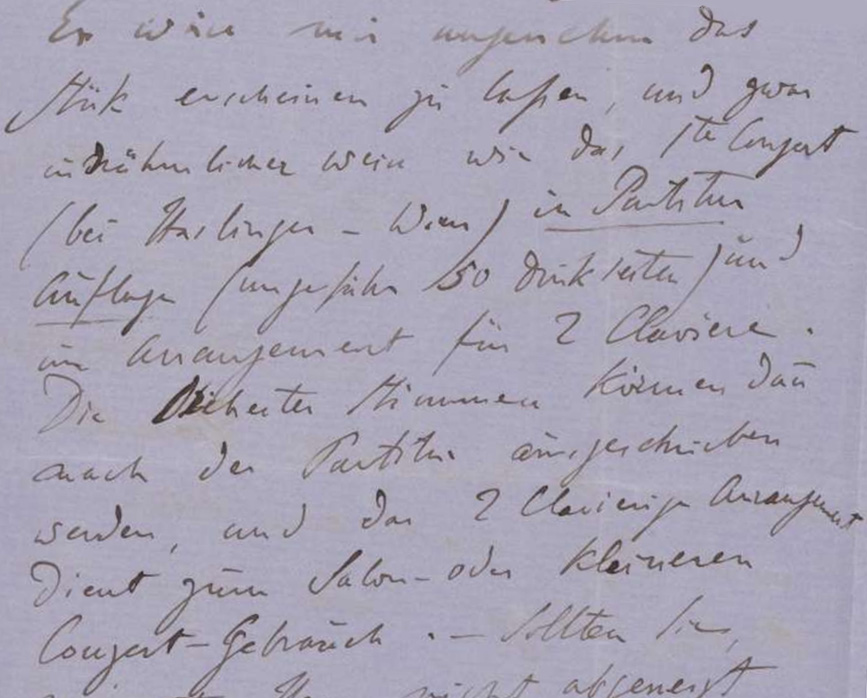
Excerpt from Liszt’s publication offer of the 2nd Piano Concerto to the publishing house B. Schott’s Söhne (letter of 22 January 1859, Berlin State Library): “I would be pleased to have the piece [= 2nd Piano Concerto] published in the same manner as the 1st Concerto …”.
The significance of this previously unknown source can be illustrated by a striking example. Showing up in the piano part is a curious left-hand discrepancy in measure 496 as compared with the printed full score and piano reduction.
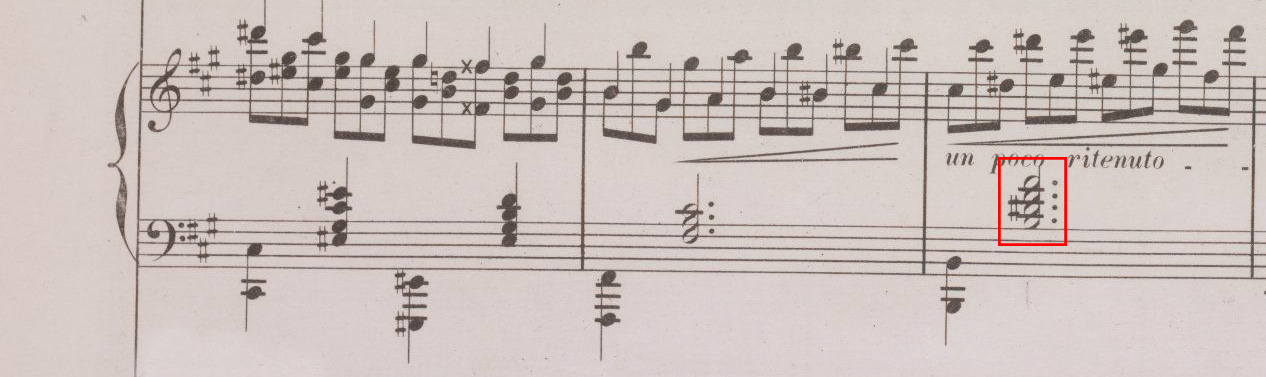
Full score, mm. 494–496
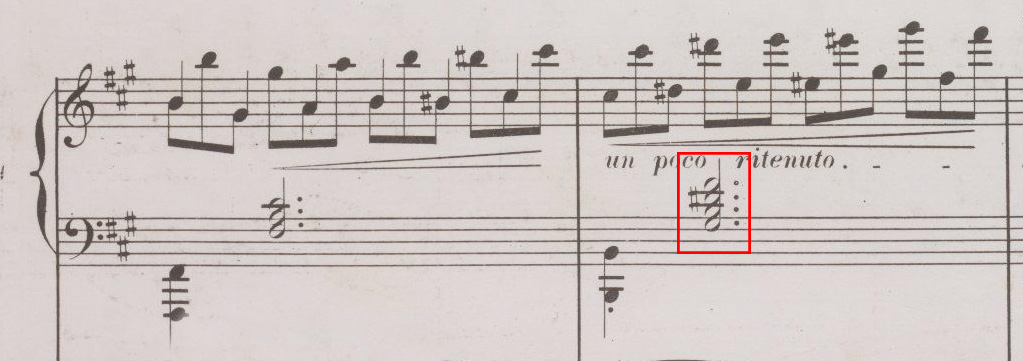
Piano reduction, mm. 495–496
In the full score, we have on beat 2 the chord b/d sharp1/f sharp1/a1, which is harmonically correct, as the B-major seventh chord is also heard in the orchestra. Printed in the piano reduction is, however, g sharp/b/d sharp1/f sharp1; no question about it, g sharp does not fit the harmony – is it simply a printing error? The passage seems even odder, upon examining the sources preceding it.
Measure 496 is one of the passages that underwent multiple changes; its apparently final form was achieved in Liszt’s correction of an earlier copy made by Joachim Raff, his assistant at the time. There, the chord is notated in the autograph rewrite as f-sharp/a/d-sharp1/f-sharp1, a notation adopted in the Bronsart copy and left unchanged by Liszt. The question of how the harmonically appropriate but compositionally different reading came to be in the printed score can be answered by looking at the engraver’s copy.
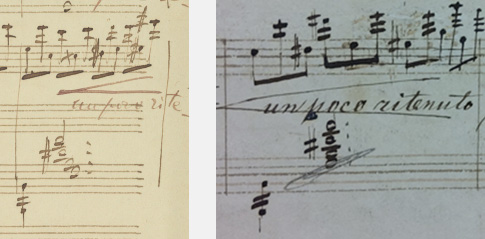
left: Autograph notation (Weimar, Goethe- und Schiller-Archive)
right: Notation in the engraver’s copy (Munich, Bavarian State Library)
Götze made a mistake by notating the chord as g-sharp/b/d-sharp1/f-sharp1. Since this copy also served as the engraver’s copy for the piano part in the piano reduction, the error was carried over into the printed piano reduction. Since the incorrect g sharp was later crossed out in pencil by an unknown hand, it was probably already missing in the now-lost galley proofs, in which Liszt must then have added the now-lacking seventh, a1. We could speak of a productive error here, for the change from the original f sharp/a/d sharp1/f sharp1 to the definitive b/d sharp1/f sharp1/a1 was probably authorised, though certainly not intended. In our Urtext edition, we have therefore adopted the latest version with b/d sharp1/f sharp1/a1, though referring in a footnote to the chord’s ‘history’, which can be read in the comments.
Thus, studying the full-score engraver’s copy enables clarifying at least part of the controversial questions or contradictions concerning the music text in our Urtext edition (HN 941), which is no small feat given Liszt’s notorious “obsession with improvement.”