
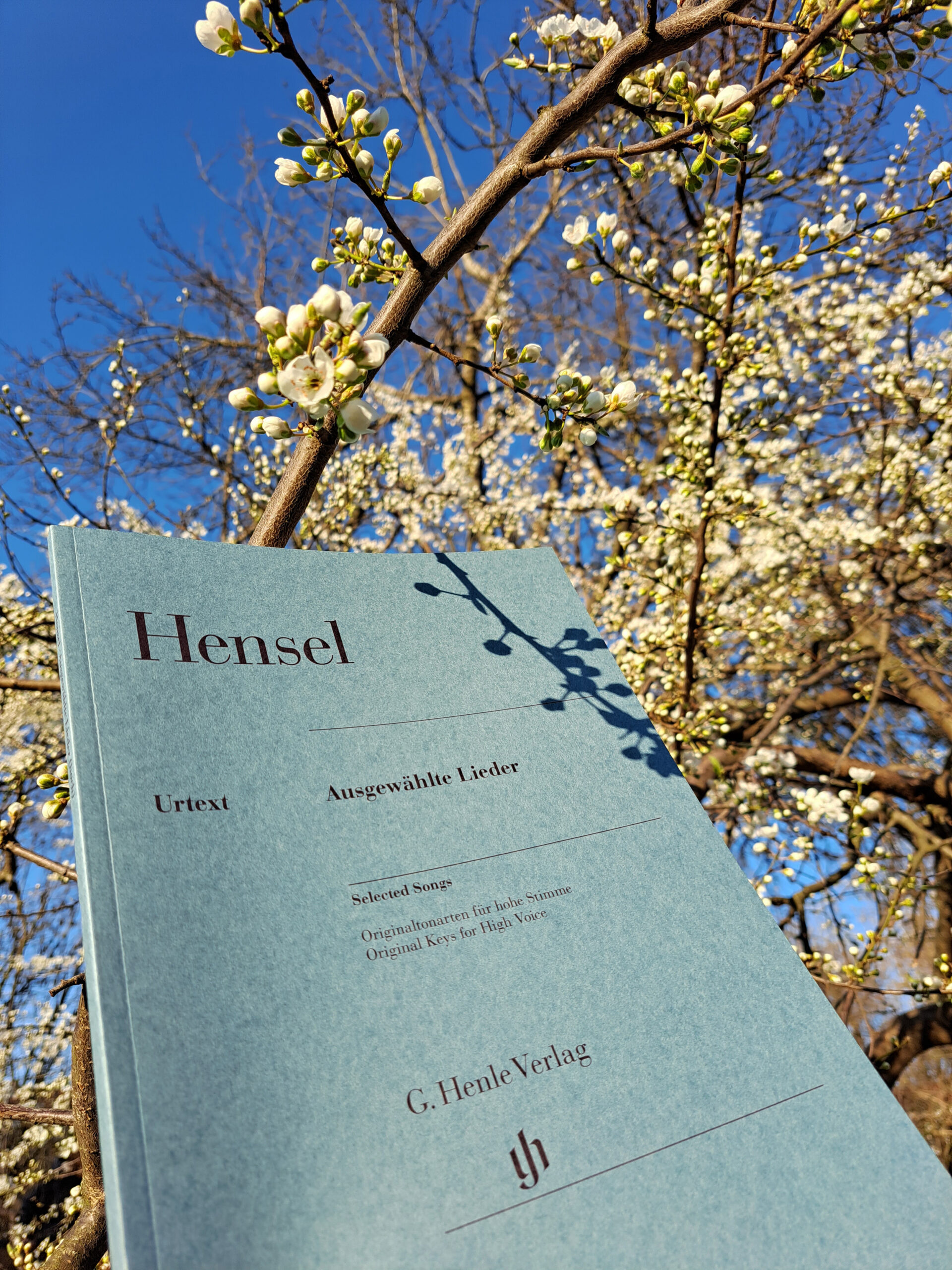
 249 of altogether 466 works listed in her works’ catalogue leave no doubt: the lied was central to Fanny Hensel’s compositional output! From the first extant composition by the 14-year-old – a lied written in 1819 for her father’s birthday – to the last, inscribed in 1847, the lied runs like a red thread through her entire oeuvre. It’s therefore high time that a volume of songs (HN 1610) was finally added to the anthology of piano works (HN 392) published by Henle publishing house decades ago!
Especially since the current state of research on Fanny Hensel, née Mendelssohn Bartholdy, is practically ideal for an Urtext publishing house. The oeuvre of this composer – who, until the 1980s, was perceived merely as “the sister of” and thus vastly underestimated – has since been documented in a scholarly works’ catalogue; a large portion of the surviving sources in the Mendelssohn Archive at the Berlin State Library are accessible online; letters and diaries have been scholarly edited; and numerous studies on her life and work have been published. Last but not least, the online platform Hensel Songs Online, where tenor Timothy Parker-Langston presents transcriptions of all Fanny Hensel’s lieder, provides a comprehensive overview of the lieder. What more can be desired?!
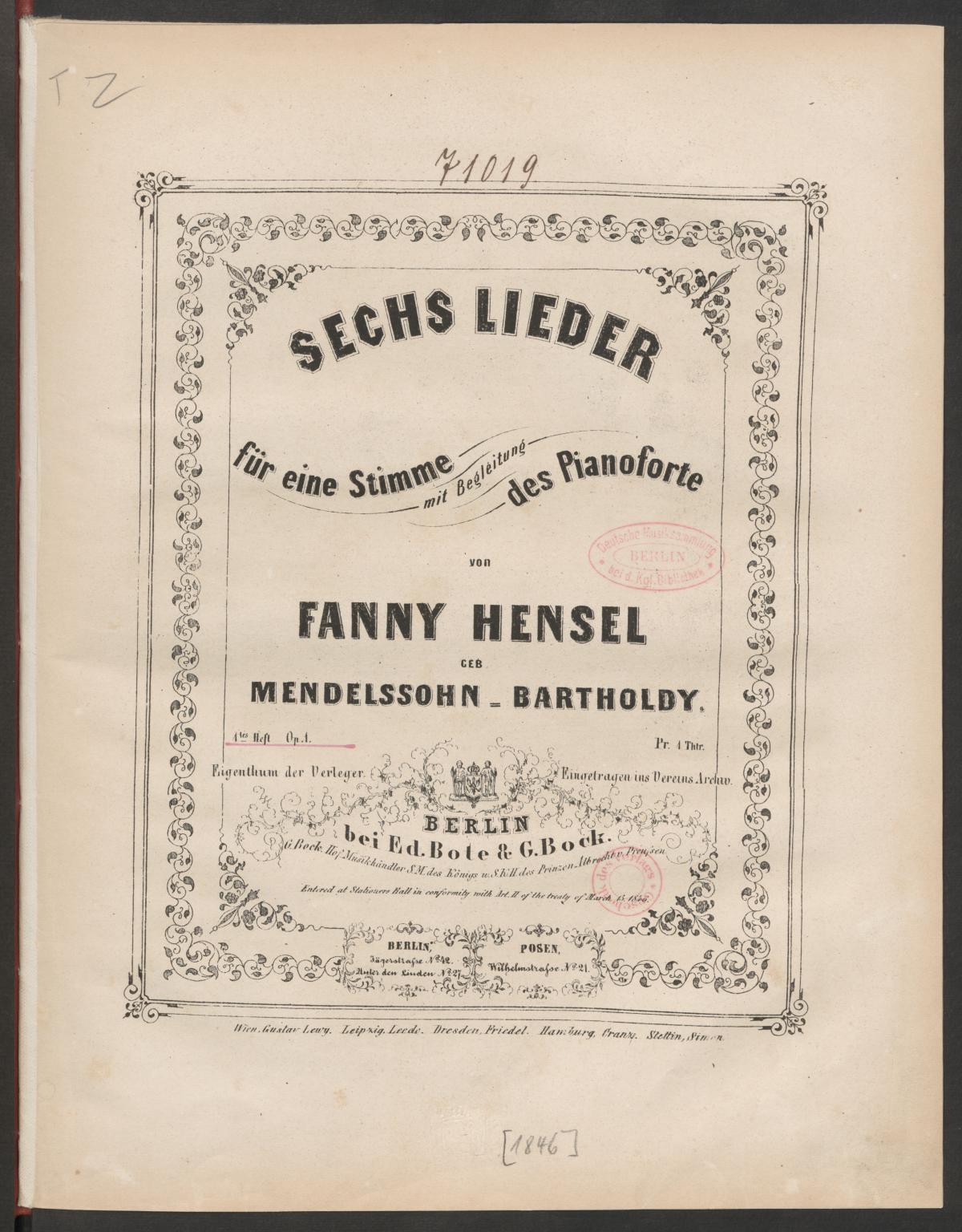
First edition of op. 1, D-B DMS 71019
All that remained was the small but not insignificant question of which of the 249 lieder would be suitable for the planned anthology: Should we limit ourselves to previously unpublished works? Would it be better to select lieder based on a single poet’s texts or to concentrate on a specific period in the composer’s life? We quickly decided that the 12 lieder published in 1846/47 as Opp. 1 and 7 should open our volume: They comprise a selection of lieder she composed between 1839 and 1846 to texts by Goethe, Heine, Eichendorff, Rückert, Lenau, and Geibel. Thus, at the age of 41, Fanny Hensel had finally introduced herself to a wider audience; this was how she wanted to be perceived by the public as a lieder composer.

“I am thrilled that Hensel’s songs are now finally finding their place in the canon of 19th-century lieder.” – Stephen Rodgers
With this in mind, we focused on earlier works and expanded the circle of poets to include names such as Uhland, Tieck, and Klopstock, in order to place the lieder from Opp. 1 and 7 within the context of her entire lied output. Another consideration was the availability of sources: the lieder needed to be extant in multiple sources to provide a solid foundation for the edition. With the scholarly expertise of the renowned Hensel scholar Stephen Rodgers and the practical experience of the singer Juliane Banse, who provided invaluable support in our work on this volume, we arrived at a selection illuminating many facets of Fanny Hensel’s lieder writing – from simple strophic songs (An einen Liebenden im Frühling, 1824) to dramatic miniatures (Harfners Lied, 1826) to large-scale songs (Gegenwart, 1833).

“I hope that with each of these (re)encounters, your love and admiration for Fanny Hensel will grow and that you will continue to spread this wonderful music throughout the world!” – Juliane Banse (Foto: Elsa Okazak)
Working with the sources then held a few surprises, which, for me personally, made this lieder volume one of my most cherished editorial projects. This already begins with Fanny Hensel’s composite manuscripts: She chronologically filled music paper, page by page, meticulously noting the place and date, or she had individual works from a specific period later bound into collections. The albums preserved in the Mendelssohn family estate offer a well-organised and presumably nearly complete documentation of her creative output from March 1820 to December 1846. They bear witness to the self-confidence of a composer who, from the age of 15, was repeatedly told that for women composing could only be a hobby. At the same time, they provide insight into her compositional style, as these early manuscripts often contain numerous corrections.
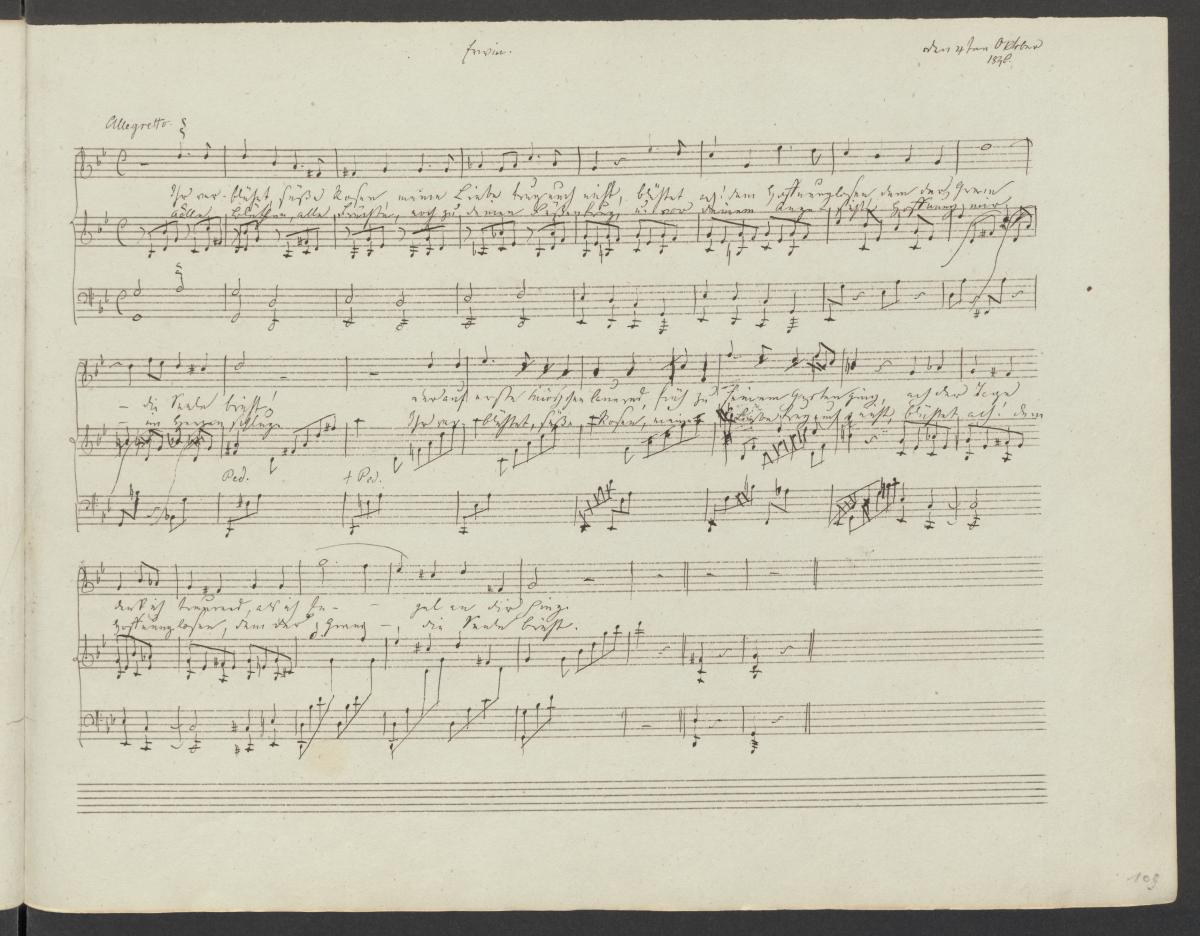
Erwin, autograph, D-B MA Ms. 49, S. 109
She furthermore often wrote down her lieder for others: whether a song cycle for her brother Felix or a volume for her husband Wilhelm Hensel, to whom she presented (presumably for their 10th wedding anniversary in 1839) a “Selection From My Books. Sixty-Seven Lieder for One or More Voices”. A particularly fine example is the “Travel Album” from her 1839/1840 Italian trip: Fanny Hensel recorded there 18 compositions composed during the trip or fitting the context, whilst Wilhelm Hensel created an artistic title page and added at the beginning of each piece coloured vignettes referring to the lieder themes.
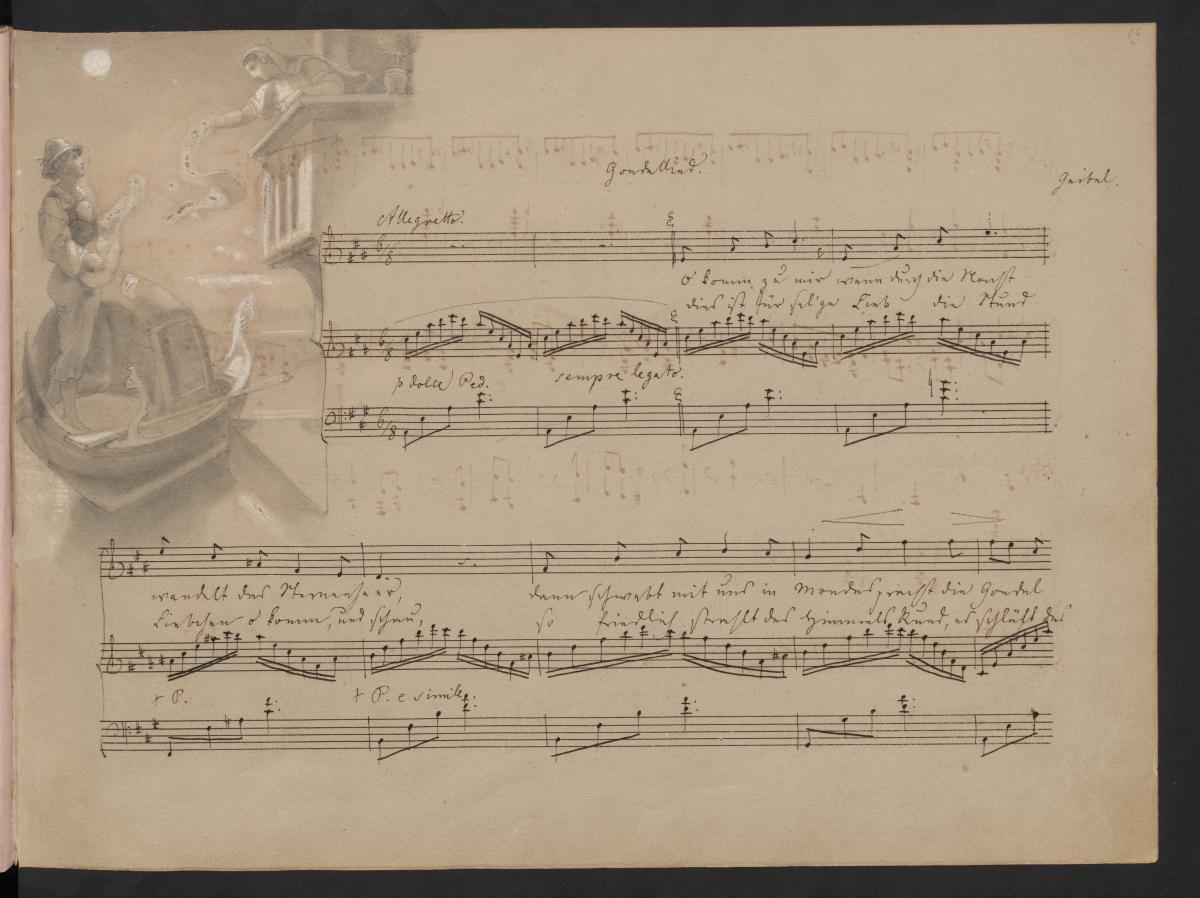
Gondellied, autograph, D-B MA Ms. 163
Particularly valuable for this edition are albums composed for others, as well as individual transcriptions in fellow musicians’ autograph or music albums, as they sometimes contain more information about the performance of the works – whereas indicated in transcriptions intended for personal use are often neither tempo nor articulation. Thus, only in the later transcription for Wilhelm Hensel does Frühlingsabend receive the performance marking “Suave” and nuanced dynamics. At the same time, though, a small ornament is notated in the vocal part (measure 5), the piano part is modified (cf. mm. 8–10 and 12 ff.), and the second-stanza text is altered. In the earlier autograph, this still exactly follows Ludwig Voß’s original: “Unter dämmerndem Sternenschein / wandl’ ich Mädchen mit mir allein / durch die dunkleren Gänge. / O mein bebendes Herz umwühlt, / was ich nimmer zuvor gefühlt, / wundersames Gedränge!“ (Under the twilight starlight / I, a girl, walked alone / through the darker corridors. / O my trembling heart is stirred, / by what I have never felt before, / a wondrous surge!). In the later manuscript, however, the girl walks “durch die blühende Heide” (through the blooming heath) and confesses, with “O mein bebendes Herz erregt, / was mich nimmer zuvor bewegt, / Wunderliebliche Freude!” (O my trembling heart is stirred, / by what has never moved me before, / wondrously lovely joy!), feelings that are less stirring than previously.
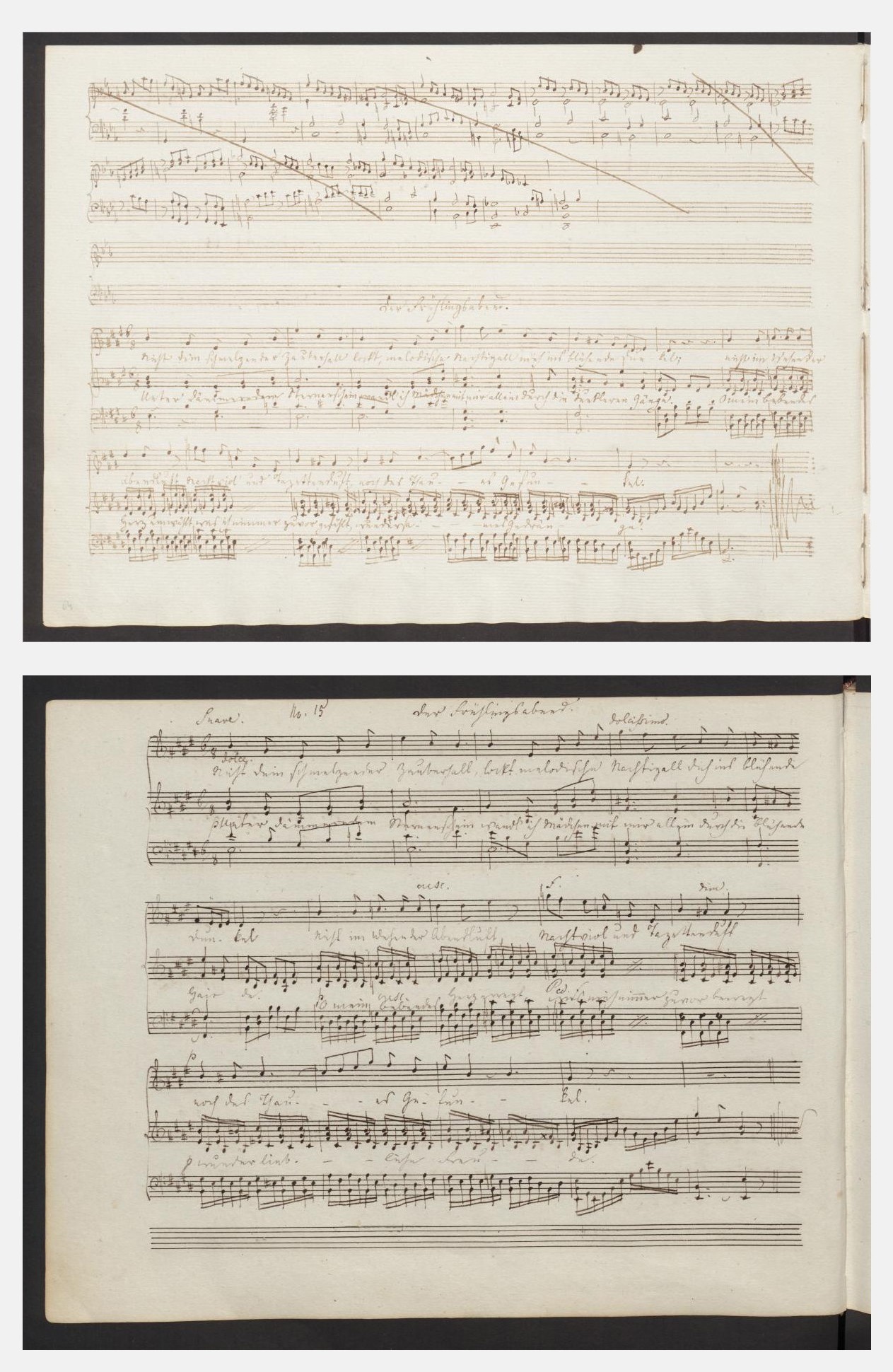
Above: Frühlingsabend, early manuscript, D-B MA Ms. 35, S. 64
Below: Frühlingsabend, late manuscript, D-B MA Ms. 128, S. 26
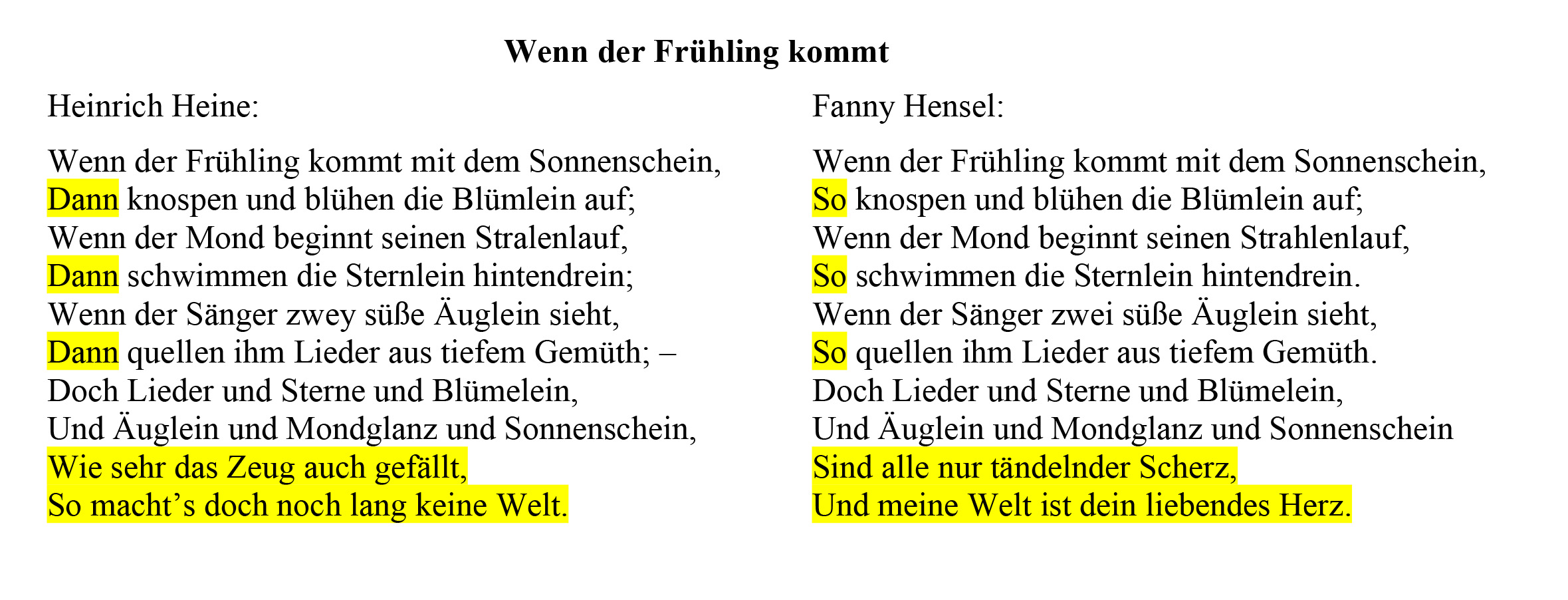
The musical and textual variants in these two autographs are typical of Fanny Hensel’s lieder composition. A comparison of the autographs reveals that with each new lied draft, details in the music text change: even rhythms become dotted (and vice versa), accents and ornaments are added or omitted, and the piano part is augmented in terms of its sound or rephrased. Sometimes the changes can be interpreted as a progressive revision of the music score towards a “final version” – at other times, they suggest, rather, equally valid variants. The comparison of the lied texts with the original poems, undertaken for our Urtext edition, shows in turn that Hensel repeatedly made linguistic or even content-related alterations. The change of the repeated “Dann” to “So” in Wenn der Frühling kommt (Heinrich Heine) can be explained by the fact that this word is easier to sing – and might even have met with the poet’s approval. But the alteration of the content in the closing verses robs the poem of its ironic punchline, thereby destroying a defining feature of Heine’s poetry.
 Upon closer examination, even the intimate nature of An einen Liebenden im Frühling also proves to be a construct of the composer. In Ludwig Tieck’s original, the poem is titled “An einen Liebenden im Frühling 1814” (To a Lover in the Spring of 1814) – thus alluding to the context of the German liberation wars and interpreting the lover as a patriot. Fanny Hensel, however, omits the year from the title as well as the entire fourth stanza specifying the political context, thereby transforming the political spring into a private one.
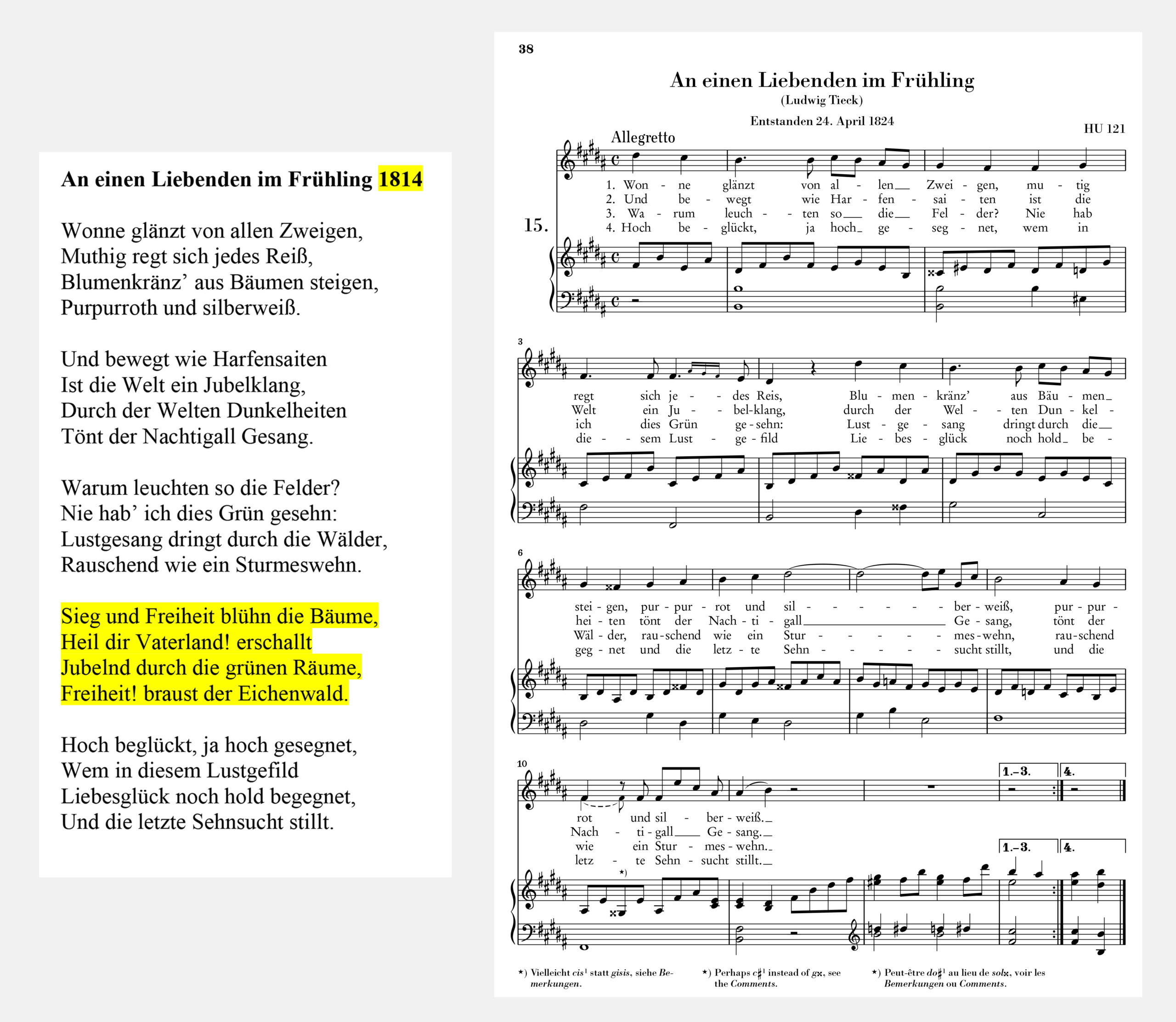
Left: poem by Ludwig Tieck
Right: lied by Fanny Hansel
Composed in 1824, this lied also offers a fine example of the almost “sparing” piano-writing style of several lieder – she could well have revised it for a printed edition and added dynamic markings, but that never came to pass. Thus, it is left to the performer’s imagination to turn Hensel’s original into a compelling strophic lied. Incidentally, the exciting results that historical performance practice brings to light, especially in the case of Fanny Hensel’s lieder, were on full display last weekend at the first International Fanny Hensel Song Competition. Why not give it a listen!