
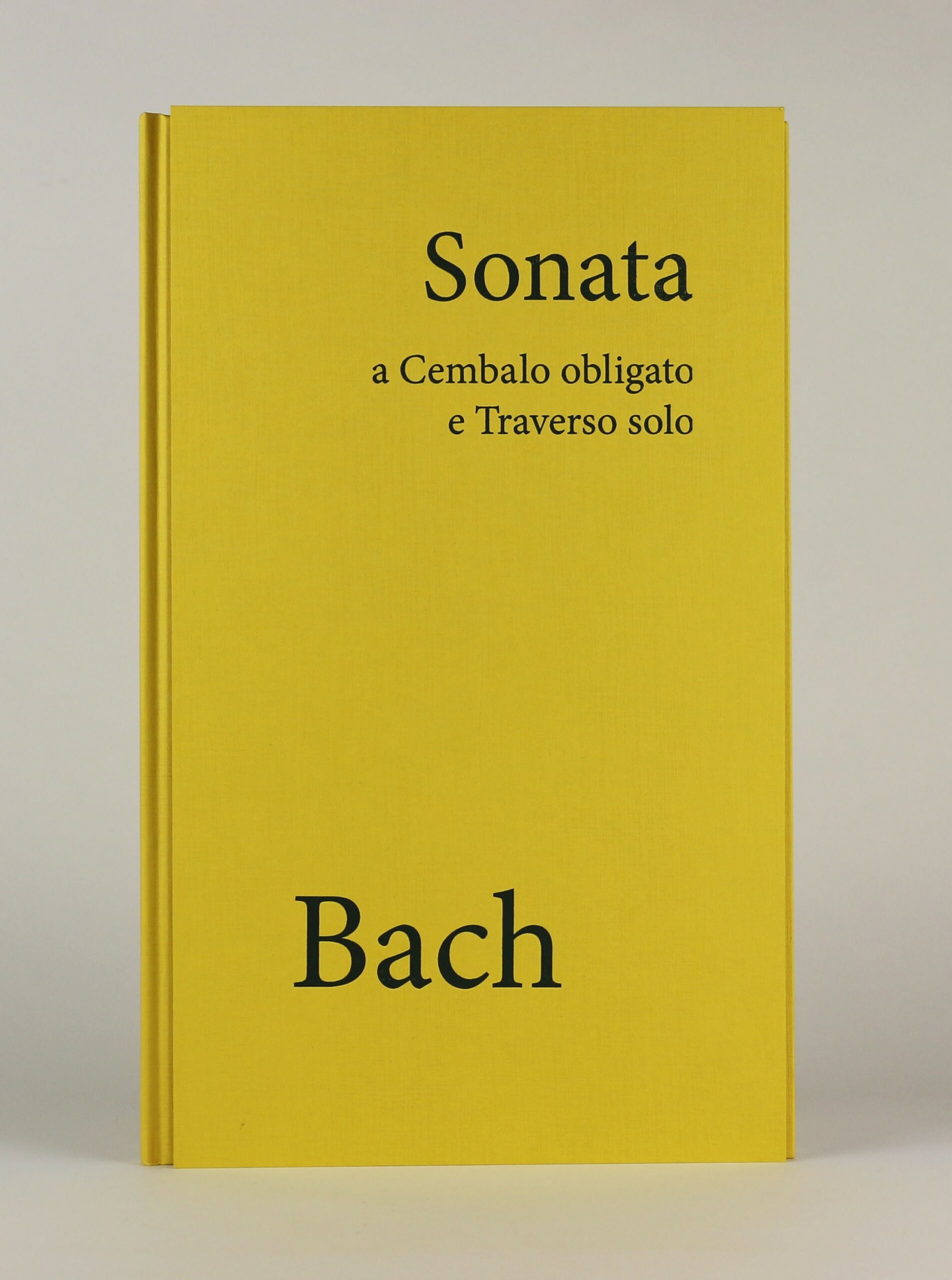
 Facsimile editions from Henle publishing house have been a recurring topic on this blog. For today’s post, though, I’d like to focus on a facsimile project I’ve personally been co-supervising: Bach’s Flute Sonata in b minor.
As much as we editors are passionate about producing further Henle-blue Urtext editions (and that, of course, remains our primary focus!), we also enjoy occasionally launching special projects that bring variety to our daily routine. Facsimile editions are just one such special product, since we, together with our production department, get to be creative right from the cover design stage, which is why Bach is suddenly appearing in yellow instead of blue. And the other work involved in such a project also differs significantly from editing Urtext editions. From image processing to determining the book format and print space – all of this is developed and managed by the production department – these are processes and issues that we in the editorial department otherwise rarely encounter.
So, while “normal” work on a facsimile already differs from our everyday editorial routine, the Bach facsimile was for various reasons a very special experience for me, and I’d like briefly to outline it.
1)
The idea of producing a Bach-manuscript facsimile originated from the sales and customer side. Two aspects played a role in selecting the manuscript: First of all, it was to be a key work as well as a particularly beautiful autograph. Secondly, no more recent facsimile of this manuscript should be available on the market. The selection quickly fell on “the” flute sonata par excellence, the Sonata in b minor, BWV 1030, whose autograph is extant at the Staatsbibliothek zu Berlin · Preußischer Kulturbesitz.
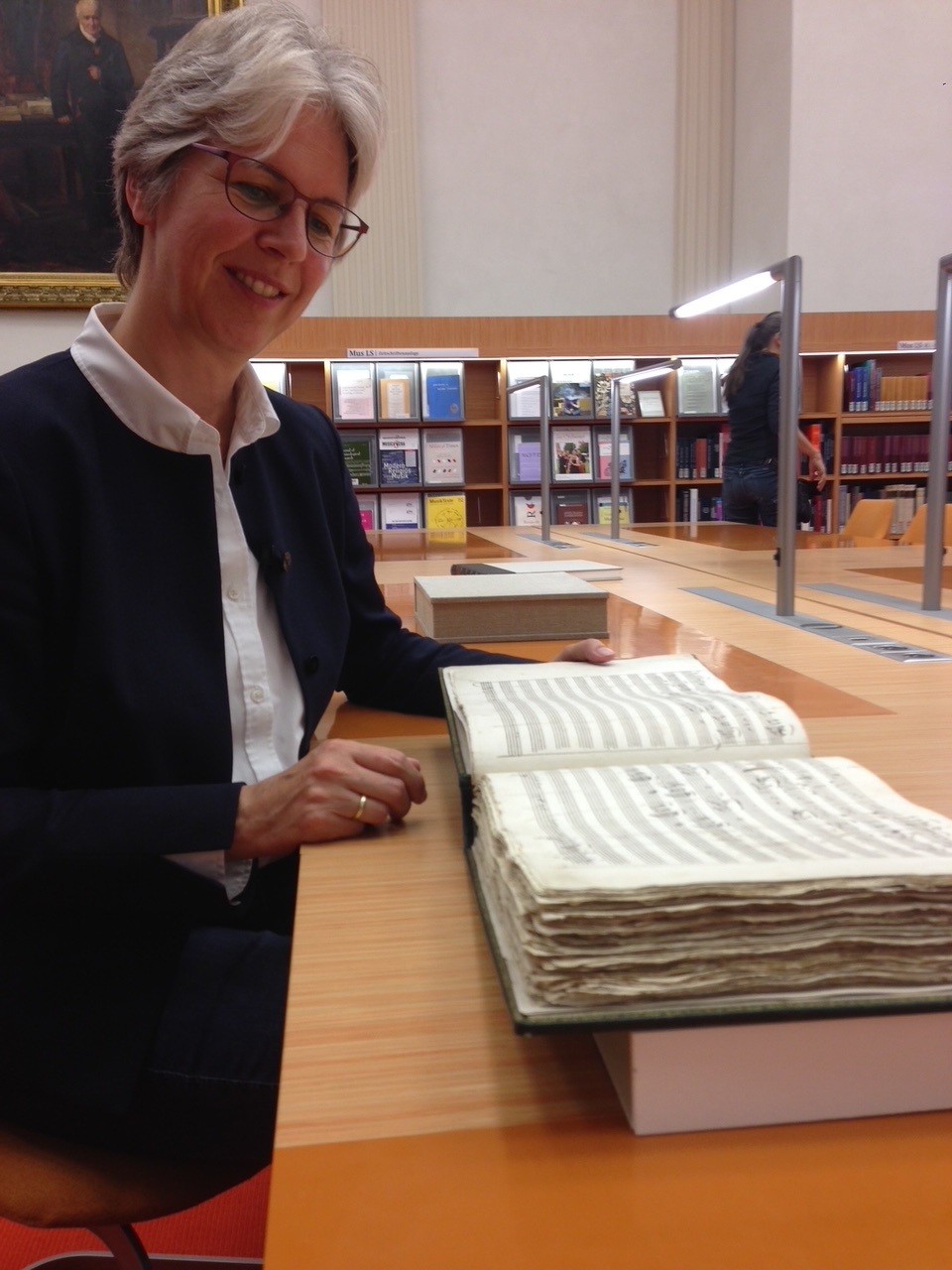
Martina Rebmann presenting Mozart’s Magic Flute,
Copyright: Matthias Miller
I contacted Martina Rebmann, head of its music department, and since I was anyway planning a visit to Berlin, I spent an afternoon there at the “Stabi” and was allowed to view and examine the original autograph in the reading room. A truly special experience! Even though I had carefully studied the digital copy beforehand – having the original on the table in front of you offers entirely different insights, especially regarding its physical characteristics, such as the arrangement of the pages (how the paper sheets are connected, how they are bound or folded), their state of preservation, etc. Martina Rebmann then explained that within recent decades many of the Bach autographs at the Berlin State Library have undergone extensive restoration. I was absolutely amazed, for even the autograph of the b-minor Sonata had been restored and preserved for the future using a special process called “paper splitting”. She gave me fascinating insights into this process, and it quickly became clear that she would write a separate accompanying text for our edition, addressing not only the significance of the Bach collection but also the elaborate restoration process. (All texts can be viewed here.)
2)
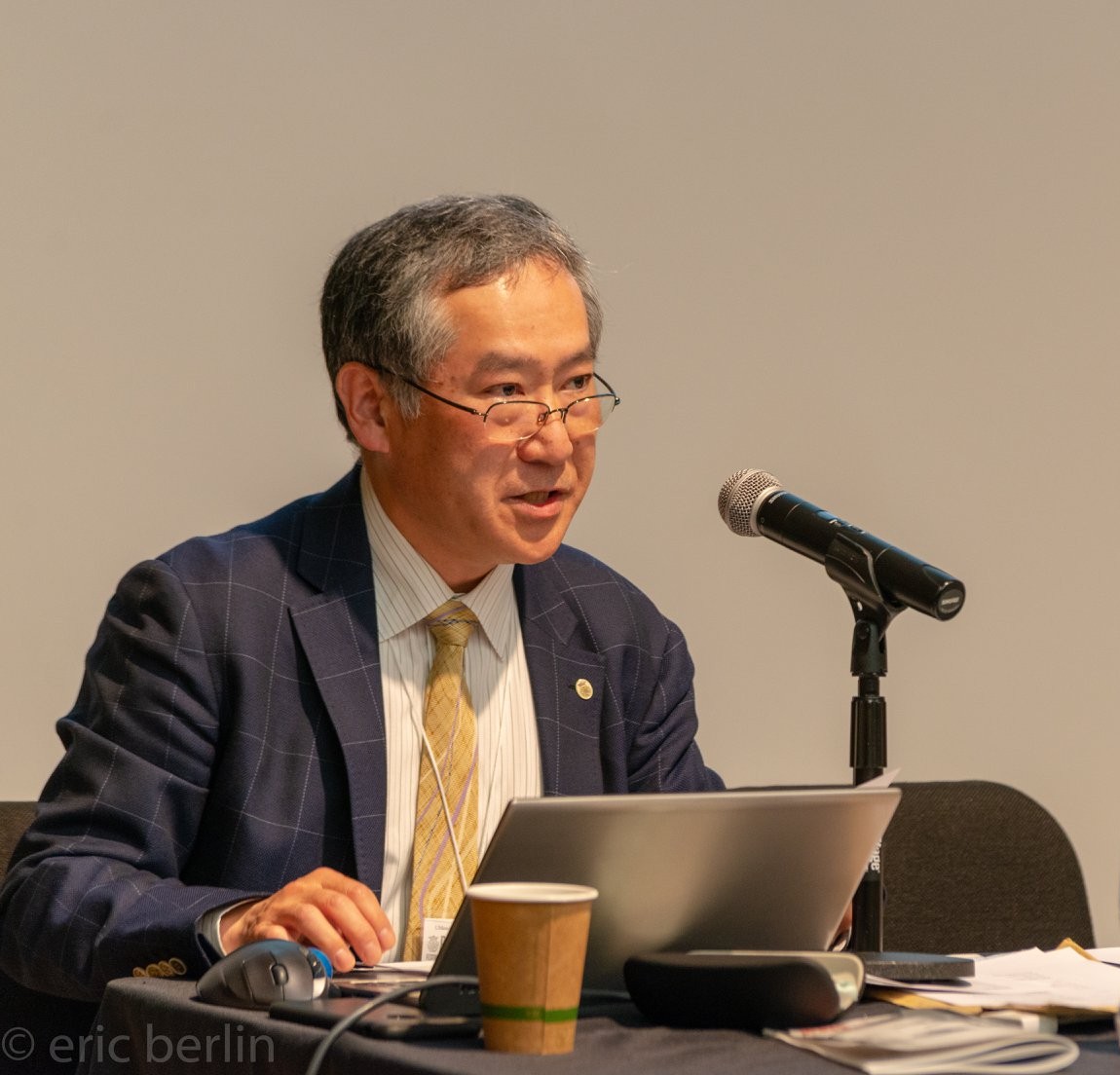
Yo Tomita
When considering who could write a scholarly commentary on the manuscript, our choice quickly fell on Professor Yo Tomita, the internationally renowned Bach scholar. We were also already acquainted with him, as he serves as our editor for the second volume of The Well-Tempered Clavier (HN 16). Tomita readily and enthusiastically agreed. And soon it turned out that one particular feature of the manuscript especially interested him. For the autograph (harpsichord part with the flute part notated above it) is accompanied by a separate flute part, which, while not in Bach’s hand, evidently dates from his time. Who wrote this part, why is it preserved together with the autograph – and how should we deal with it?
It quickly became clear that we would want to include the facsimile of the part, and at Tomita’s suggestion, we decided to insert it as a separate, loose, removable bifolio (but in a flap at the end of the book). This transforms the facsimile into a “performer’s facsimile”: musicians can perform from our edition; the harpsichordist from the autograph, the flutist from the transcribed part. Hence, they can authentically recreate the performance situation from Bach’s time.
 In researching the question of who might have written the part, Tomita eventually achieved a minor sensation. Through meticulous handwriting analysis, he was able to prove that it was in the hand of Johann Gottlieb Goldberg, a student of Bach’s whom we know today primarily through the legend surrounding Bach’s Goldberg Variations. Tomita first presented this scholarly breakthrough at a conference in Geneva, “Biennial Baroque 2023”. I felt I needed to be there, as new research findings are presented on a composer as thoroughly researched as Bach. So, I met Yo Tomita in Geneva, listened to his lecture, witnessed the enthusiastic reception of his hypothesis amongst the specialists present, and toasted Tomita’s coup that evening!
3)
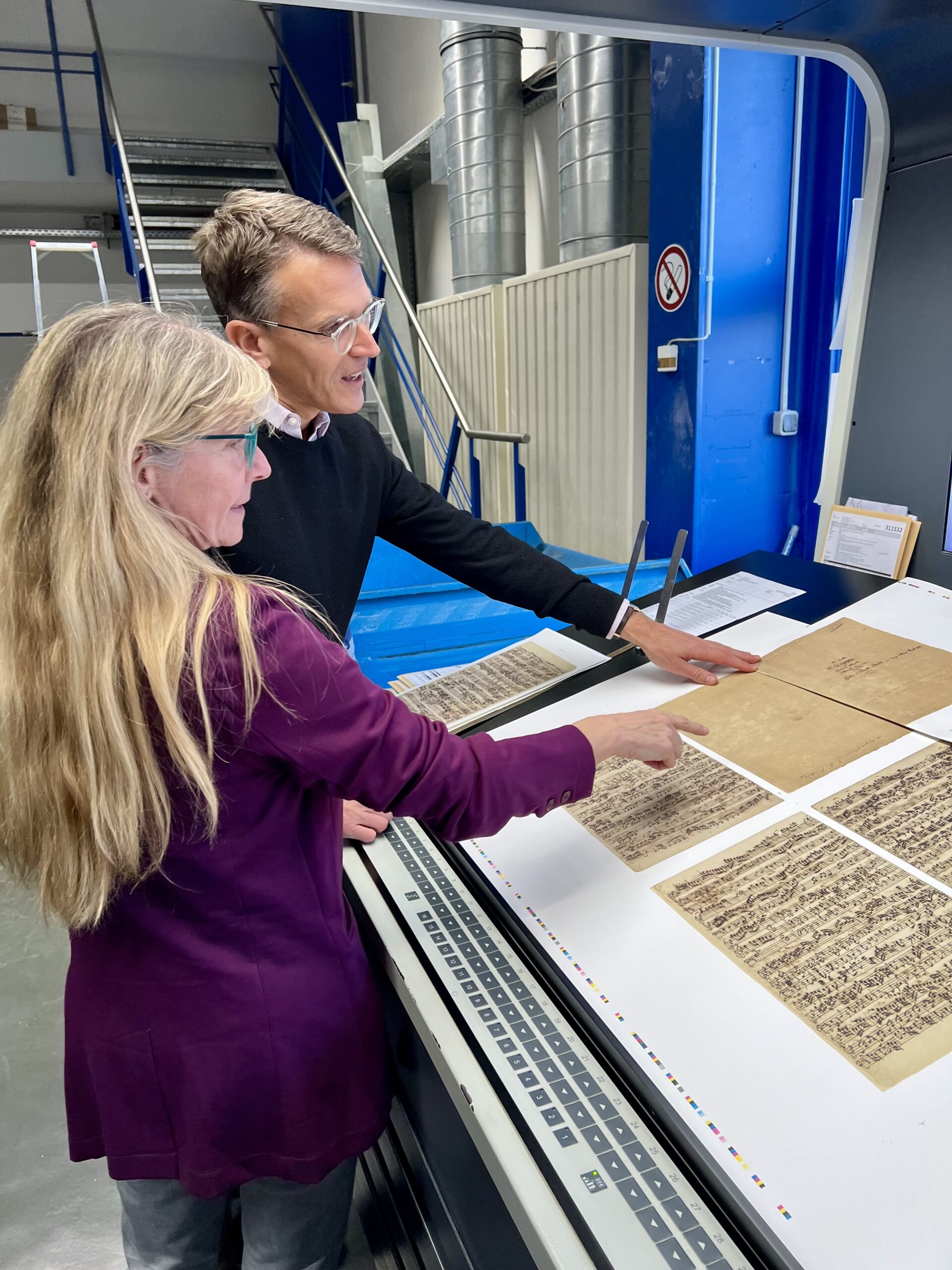
Head of Production Gabi Lamprecht and I whilst printing the facsimile at the Memminger Medien Centrum
And finally, the last “act” of this exciting project: the printing at the Memminger Medien Centrum. With facsimile prints, it’s meanwhile become almost standard practice for us to be present. After all, the printers can still make adjustments at the press whilst the first sheets are being examined on the light table for quality control, and we can still request changes to the results (lighter, darker, more red, less blue, a deeper black…). In rare cases, we even have the original on site and can then truly match the colour scheme to the manuscript as closely as possible. With the Bach facsimile, this wasn’t feasible, since, if possible, Bach autographs no longer travel! Using proofs, we had largely completed in advance the colour-matching process. Proofs are prints simulating the colour scheme as closely as possible for inspection prior to printing; they were, of course, also sent to Martina Rebmann in Berlin, who compared them there with the original. Based on these proofs, her comments (as well as my memory of the originals), we were then able to make adjustments until everyone was satisfied.
It is, however, important to keep in mind that a facsimile approximates the original as closely as possible – it does not replace it. Complete conformity cannot be achieved. An important point, making us realise that even in an age of quick and easy reproduction, the value of originals is in no way diminished!
A very special project, then, that I shall long remember, in all its aspects. I would like to take this opportunity especially to thank Martina Rebmann and Yo Tomita for the wonderful collaboration!
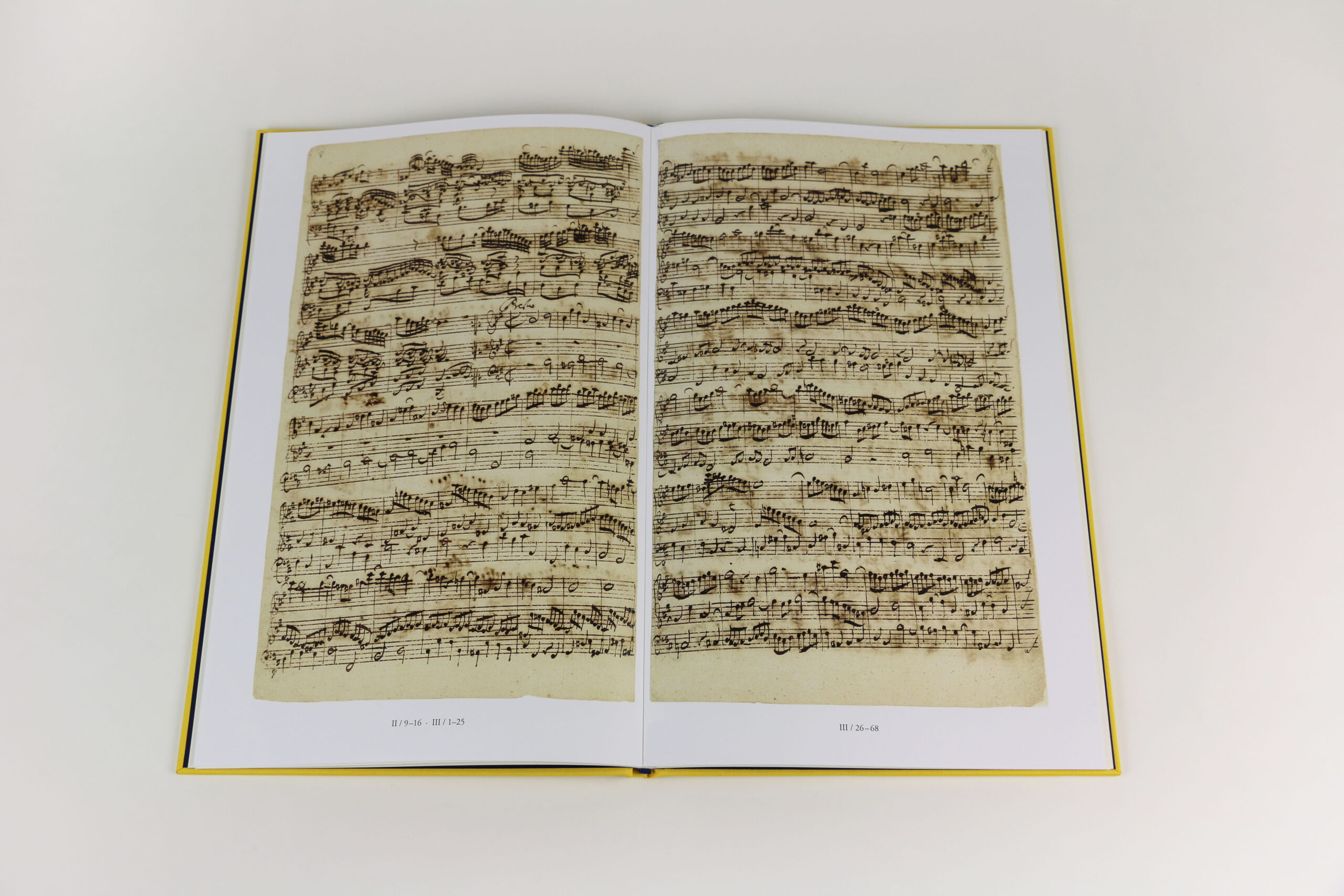 And finally, the question: Why, in fact, yellow? Well, this is where it gets very subjective, but when I asked myself which colour would suit this very special flute sonata, I saw in my mind’s eye something bright and luminous. And after reviewing countless paper and cardboard samples, we settled on “Bach in Yellow”. Anyone looking closely, though, will also discover our corporate colour, blue, in the embossed title….