
Every edition is different. The work itself often captivates. Sometimes, a particular source situation makes editing methodologically interesting. What really grabbed me as the editor of the Urtext edition discussed in this blog post is not just the outcome, but also the incredibly varied path leading there.
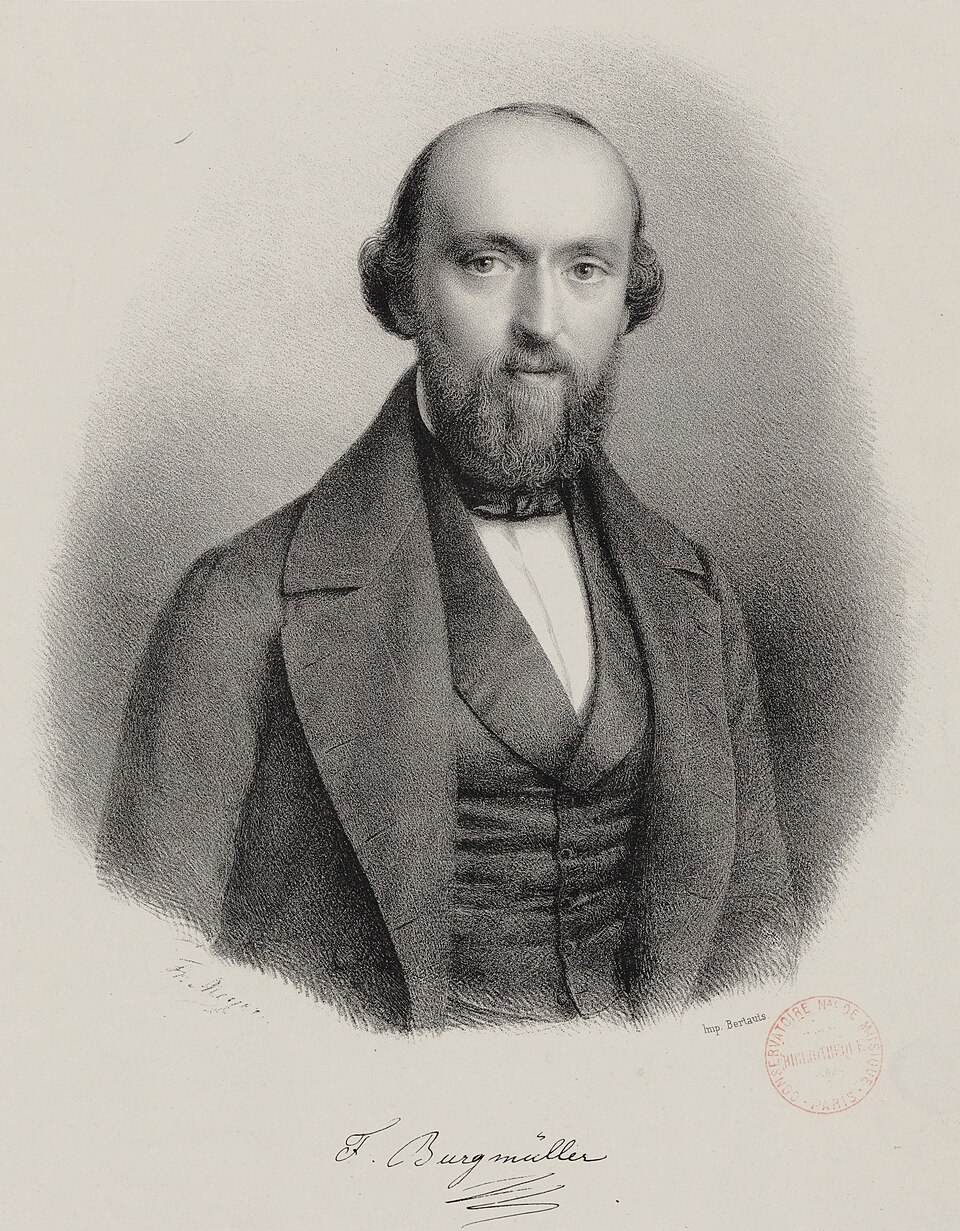
Friedrich Burgmüller, Lithography, ca. 1840
When I was assigned to edit the 25 Etudes, op. 100, by Friedrich Burgmüller (1806–1874), my first thought was: “Burg who?” Looking back, though it’s hard to believe, those standard piano pedagogy works called “Etudes”, “Instructor” (“Lehrmeister”), or “Melodious Exercises” hardly arose in my own piano lessons, and, in fact, I remained largely untouched by the Burgmüllers, Hanons, Diabellis, and Czernys. So, I approached the Burgmüller edition without any personal childhood memories, idealisation, or any bad experiences. And in the following months, I had many of those smaller and larger episodes that make the profession of editor so varied and rewarding.
My first discovery was the pieces themselves. In the 19th century, loads of pieces were composed that were called “Etudes”: by Chopin, by Liszt, by Charles Valentin Alkan (the almost even more virtuosic finger-twister) – or, on the other hand, just simple finger exercises belonging to the elementary piano-pedagogy level. Burgmüller’s Etudes occupy a truly wonderful position somewhere in between. According to the original French title, they are easy, of increasing difficulty, and equipped by the composer with fingering specifically for small hands: “25 Etudes faciles et progressives pour le piano, composées et doigtées expressément pour l’étendue des petites mains par Fred.ic Burgmüller” (who, although a native of Regensburg, worked in Paris and also became a French citizen).
At first glance, this title sounds rather dull and pedantic. But Burgmüller’s étude collection doesn’t simply present a series of dryly numbered finger exercises; instead, it consists of 25 delightful little character pieces. Titled “Arabesque”, “Tendre fleur” (“A Tender Flower”), and “La Styrienne” (“Styrian Dance”), they are vivid, catchy, rhythmically lively, and melodically charming. Real music, if you will, into which the respective technical exercise itself is cleverly woven. That, I liked immensely, and it quickly became clear that with our edition, we didn’t just want to hand young players a score without commentary, but rather to guide them and explain what they are seeing there in front of them. Of course, our focus in this context was not on the editorial methodology (which, as customary in the Henle Urtext edition, is explained in the Comments at the end of the edition). No, we were thinking about the musical and technical-exercise features of the individual pieces. Why would this Etude be called “L’Hirondelle” (“The Swallow”)? What musical characteristic would bring to mind the little bird with its acrobatic flight – and what exactly is being exercised with all those high notes that Burgmüller notated for the left hand, constantly requiring you therefore to cross over the right hand?
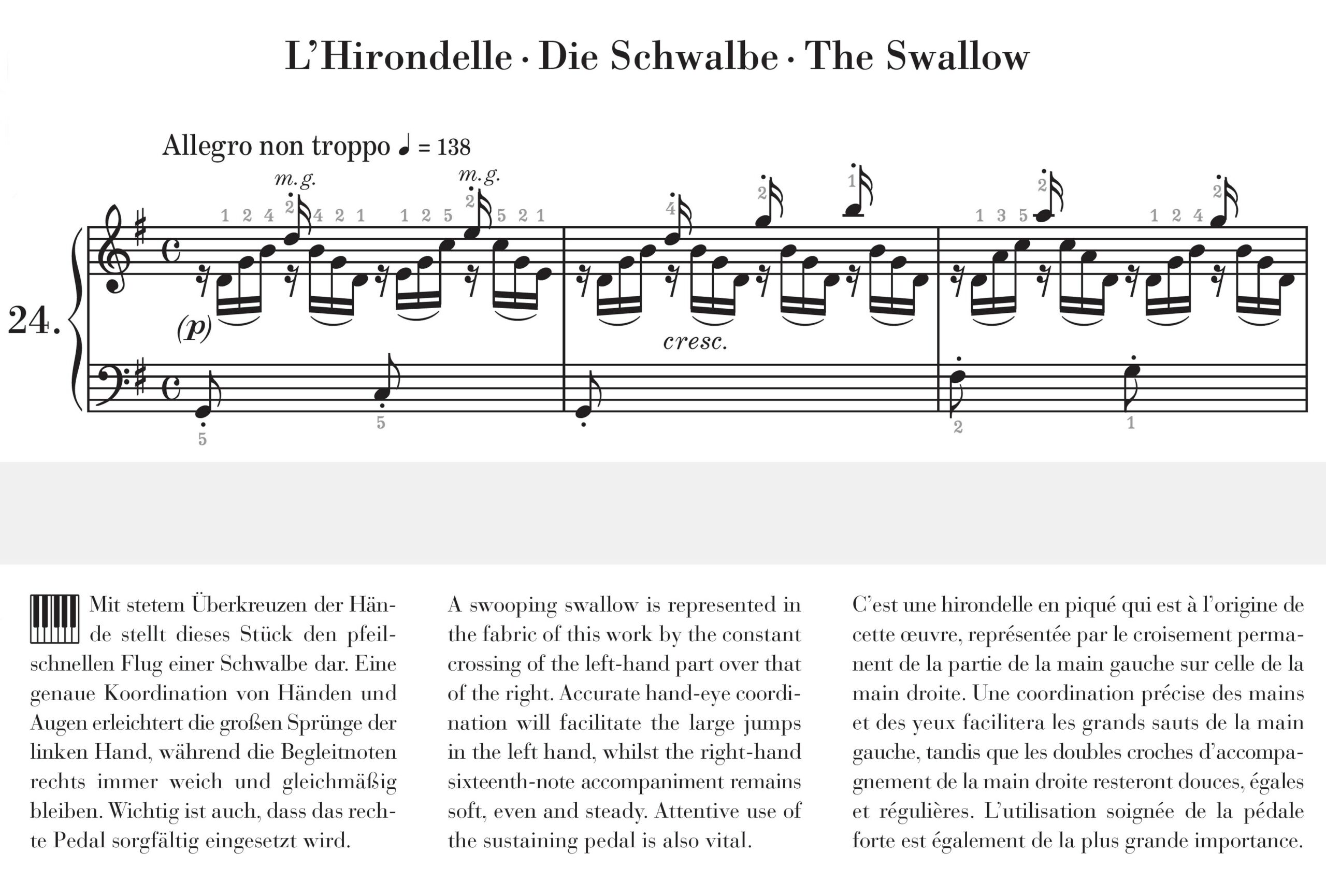
above: Opening of “L’Hirondelle”, Henle Urtext, HN 1726
below: “L’Hirondelle”, accompanying text by Melanie Spanswick
For these explanatory notes, we were able to enlist the renowned piano pedagogue Melanie Spanswick, who wrote truly enchanting texts for us. In addition, she expanded Burgmüller’s insightful, but somewhat sparse, original fingerings with further information, ensuring that during playing no fingering questions remain unanswered. Of course, Spanswick’s fingering additions (printed in grey) are easily distinguishable from Burgmüller’s original (in black). Henle Urtext is Henle Urtext.
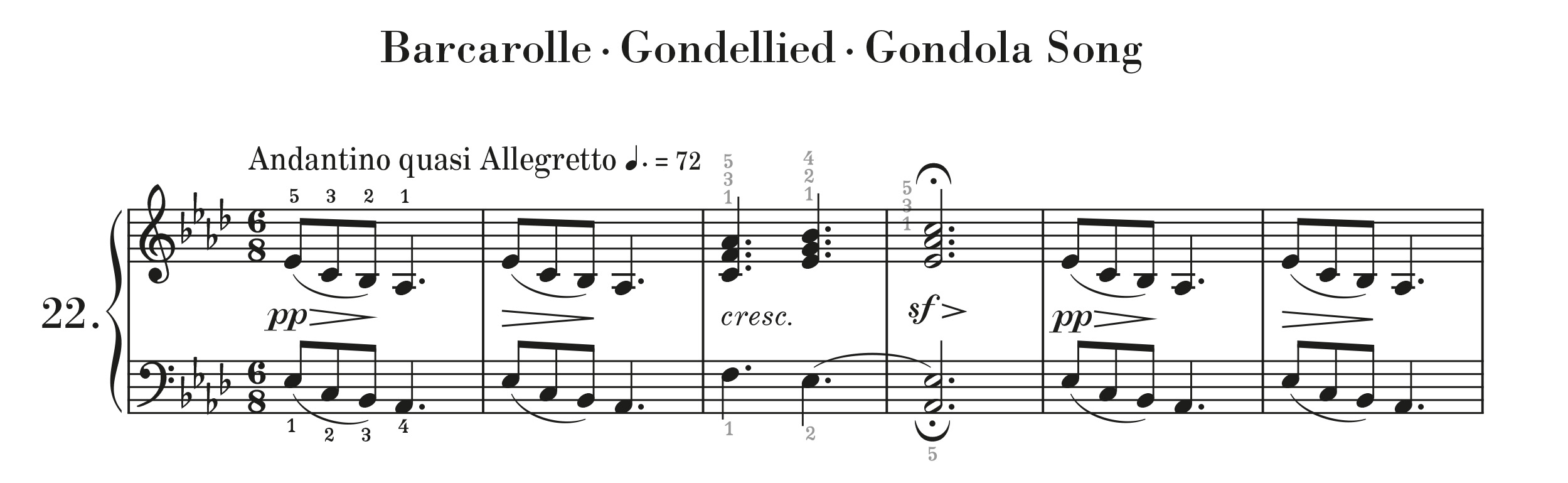
The composer’s original fingering (in black) with helpful
additions by Melanie Spanswick (in grey)
Anyone opening our Burgmüller Etudes will see music pages that are distinctly different from those in other Henle editions. To showcase effectively Spanswick’s explanations in German, English and French, we devised a new design. We didn’t want to cram the explanations onto mundane pages of text, but rather to place them where they belong: directly with the music pieces, clearly relating the music and text to each other, thus, attractively designing the whole piece as a “total artwork”. No, we didn’t commission anyone to draw illustrations for the pieces, an embellishment here, a pretty nature scene there – such a picture-book-like overextension of the Henle design guidelines would have risked Günter Henle’s hurling lightning bolts from heaven. But using our famous, clear Henle notation, the easily readable texts at the bottom of the music pages, and an almost daringly bold piano-key icon as a design element, we have created what I personally find to be a stunning graphic design that makes you want to browse through this edition and play from it.
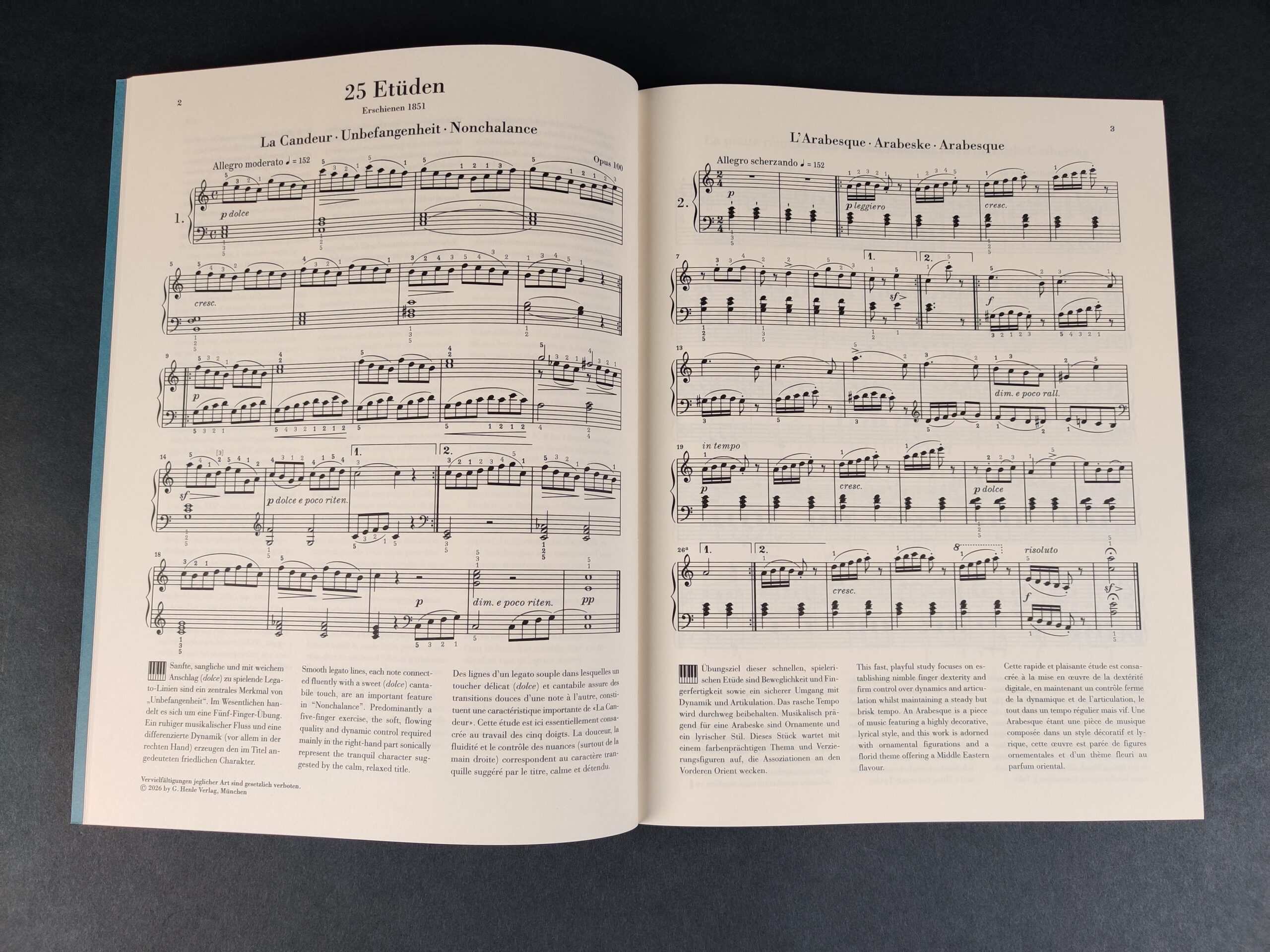
Combining music and commentary, new approaches in the Henle layout
Another graphic element immediately catches the eye upon opening the book: the coloured frontispiece showing Burgmüller’s autograph manuscript of the Etude “La Pastorale”.
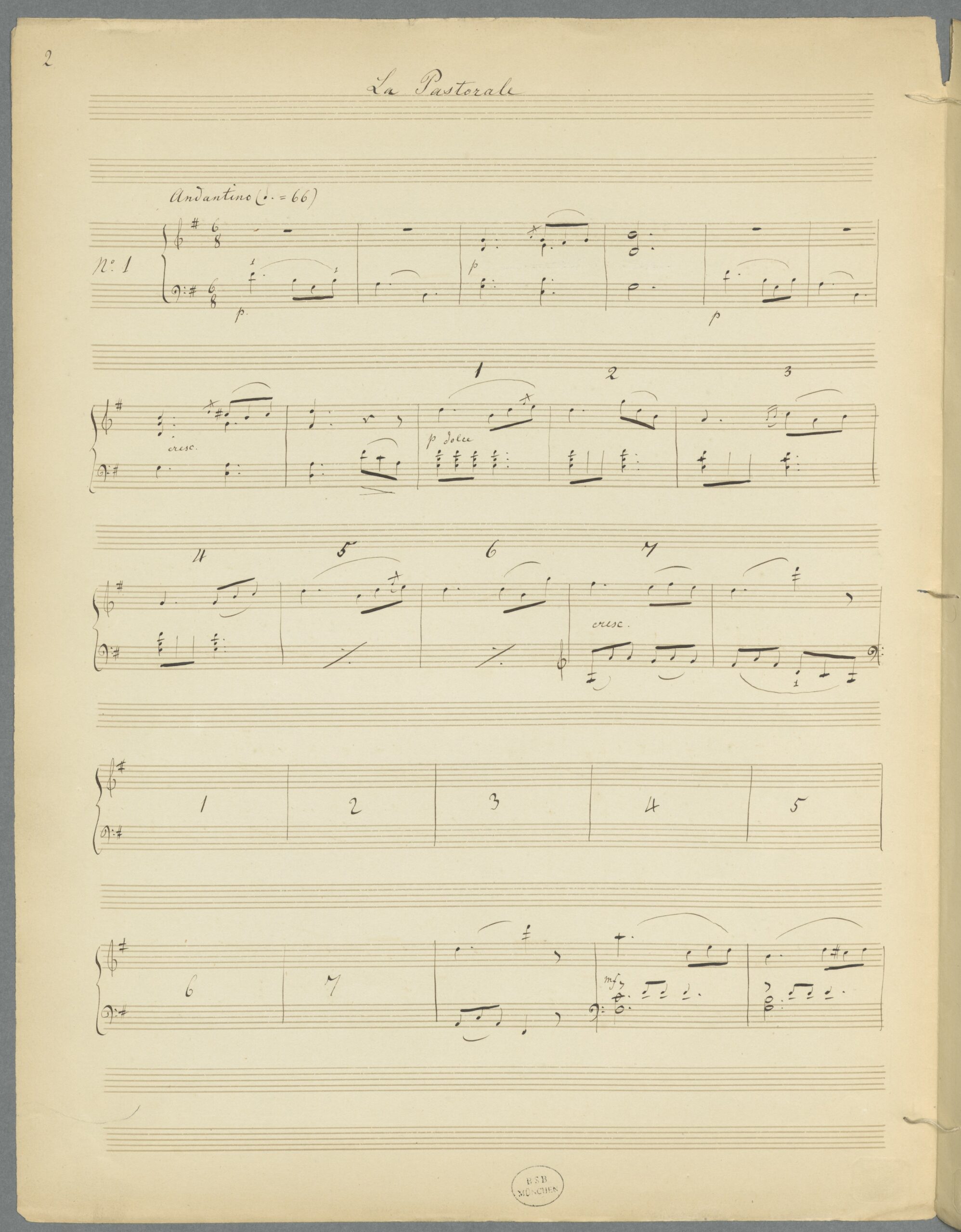
“La Pastorale”, Later version based on the manuscript,
B. Schott’s Söhne Historical Archive,
Bayerische Staatsbibliothek,
Shelfmark Mus.Schott.As 73-1
This autograph represents the volume’s distinctive editorial highlight. During my research on the Burgmüller Etudes, I soon came across an original manuscript, from the historical archives of the Schott Music publishing house, preserved in the Bavarian State Library. We ordered the source, I sat down in the reading room – and was initially quite disappointed. This “Pastorale” in front of me, this “Arabesque”, and several other pieces were not “my” Burgmüller Etudes at all. Completely different music. Such a beautiful autograph – and utterly useless for my edition. Then it clicked. These were indeed my Etudes. Just different. Sometimes, the title simply bore Burgmüller’s autograph comment, “To be taken from the Etudes.” Notated sometimes were the opening measures of a piece, sometimes several, even many measures familiar to me musically, others unfamiliar, interspersed with blank measures as placeholders. Strange! Finally, a picture emerged: Burgmüller had selected some of the Etudes from opus 100 and regrouped them. He had even compositionally reworked five of the Etudes, changing the order of their individual sections, adding a new introduction or conclusion – and in doing so, he employed a kind of abbreviated notation in which complete pieces emerge from what is written in the autograph and those measures to be inferred from the Etudes, op. 100. A compositional development, then, versions of the works previously unknown. In our edition, they are presented in an appendix, for the first time ever as edited music scores.
What gave me great pleasure was collaborating with all who contributed to this edition and its many components. Our music engraver, Paul Hangstein, meticulously worked on the layout, on font sizes, column widths, and experimented with different icons. Melanie Spanswick and our English super-translator, John Wagstaff, worked with me to fine-tune the texts and titles. Sometimes, we were initially “lost in translation”. No translations by Burgmüller of the French titles of the individual pieces have survived. But we needed translations, because without them, many piano students would have no idea what the works were about. It was fascinating to delve into the nuances of meaning with John Wagstaff. Take, for example, the Etude “La Babillarde”. In previous editions, it’s been called “Plappermäulchen” (“Chatterbox”), “Die Tratschtante” (“The Tattletale”), or “Die Schwatzhafte” (“The Gabber or Prattler”) in German, and in English, usually just “Chatterbox”. How should we approach it? Does the title describe a lively, bustling, cheerful conversation? Or is it referring to someone who talks incessantly and annoyingly without pausing for breath? What emphasis is being conveyed, and which fits the music? And if it is a person, who’s to say it’s a woman (“Die Schwatzhafte” in German definitely refers to a woman) who talks (too) much here? Because someone in the 19th century, who wasn’t Burgmüller himself, simply assumed so? Would “Plaudertasche/Chatterbox” (referring to the person) or “Plauderstündchen/A Little Chat” (referring to the situation) be more fitting as a new German/English translation? What about gender roles in general? Take “La Chevaleresque”, for example. Here, the German/English title translations of previous editions are particularly varied: “Im Trab/Trotting”, “Des Edelfräuleins Ritt/My Lady’s Ride”, “Reiterstück/Music for a Cavalier”, “Ritterlich/Gallant”. Do the French feminine article and the meaning of the foreign word “chevaleresk/chevaleresque” in German or English lead us astray? Is it about chivalry? About elegance in general? About the elegance of a person on horseback, or simply about the motion of riding? And if someone is riding, why should they be a “Edelfräulein” (“Noble Miss”)? What would be the effect if, in 2026, a new translation used the now pejorative German term “Fräulein”? That should if possible be avoided!
Melanie Spanswick’s texts also occasionally featured delightful wordplay in the clash of languages. “La Bergeronnette” (“Die Bachstelze/The Wagtail”), for example, is a cheerfully lively piece – and so it was natural for Melanie Spanswick, in her English texts, to allude to the English name of this creature (“The Wagtail”), indicating that its restless, rapid tail movement is musically depicted. The only problem was that the German bird’s namesake, as the name suggests, doesn’t wag its tail, but rather wades around in a stream (which, incidentally, doesn’t sound nearly as playfully charming as the English version, but rather more like a stork hunting for frogs to gobble up). So, the linguistic image didn’t work – and here, as in many other places, solutions had to be found that would be effective in all three languages. Beyond the usual editorial work, this involved a splendid effort to work out many details.
I hope the result will be generally considered a success, so that this newly printed Urtext edition will bring as much joy to many as it brought me during its creation.