
 Those of us no longer quite so young will be recalling this. It was in the 1990s; people in Germany were paying with the last series of D-Mark notes, a petrol litre cost less than two marks, and TSV (Gymnastics and Sport Club) 1860 Munich played in the Bundesliga (Germany’s top football division) in light blue jerseys. The Henle Urtext editions were also already blue back then – and anyone paying cash for Henle’s 18 Mozart piano sonatas (HN 1 and HN 2), 60 litres of petrol, or an 1860s football jersey, might well have reached for a blue banknote, showing a woman’s portrait on the front and an old grand piano on the back. It was Clara Schumann who adorned the 100-mark banknote, known to everyone. But did all those recognising the 100-mark banknote from her image, also know who she was?
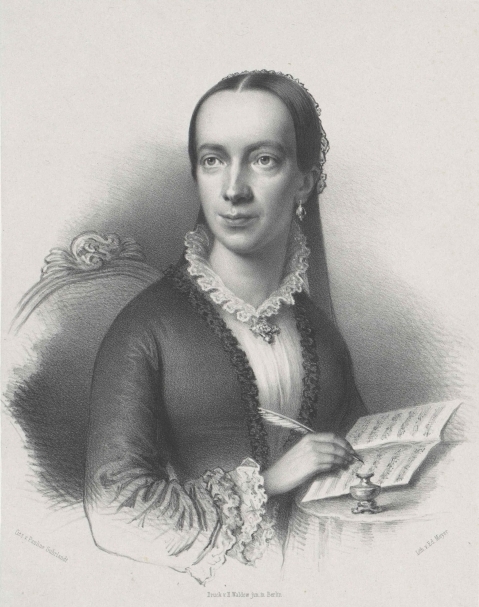
Lithograph by Eduard Meyer from a portrait by Pauline Suhrlandt
Women in the history of music remains an under-explored topic to this day. Also in the Henle catalogue. But a shift has begun. Female composers and their works are being rediscovered. Musicians are increasingly programming these works in their concerts. And, another female composer now joining the Henle publishing programme is Emilie Mayer. Living from 1812 to 1883, she was repeatedly referred to as the “female Beethoven”. According to new research, this is a misattribution – and, anyhow, Mayer’s music doesn’t need any masculine parallel. And certainly not an oblique one. Oblique parallels are, in any case, absurd.
Like just a few 19th-century women, Emilie Mayer managed to gain a career foothold as a composer. She wrote lieder, piano and chamber music, and composed large-scale symphonies. Her music was professionally performed during her lifetime – on the most prestigious-possible concert stages in Berlin and regularly before the Prussian royal family. Mayer was appointed deputy director of the Berlin Opera Academy and became the first woman named as an honorary member of the Munich Philharmonic Society. Was it all so rosy? Certainly not. When in her late 20s her father committed suicide, this was a severe blow in her life. That at least part of her musical rise in her early creative phase was due to the fact that many people initially supposed that the music of “E. Mayer” (the way she often abbreviated her name) was written by a male composer, speaks both of the good impression that “E. Mayer’s” music made on her contemporaries and of discrimination against women. In 1851, the Neue Zeitschrift für Musik stated, both benevolently and toxically:
“It is probably the first time that a lady has attempted to compose a larger work. Perhaps women in the future will also demonstrate a higher level of creativity in the music fields, as is already the case in the poetry field, and this will also eliminate the prejudice that such a talent is altogether denied to them.” (Neue Zeitschrift für Musik 23, vol. 34, 1851, pp. 247 f.)
As a Henle editor with a special assignment focusing on female composers, how did I come across Emilie Mayer? I didn’t. Before I knew it, Mayer had already come to me – in the person of the cellist and musicologist Seonhwa Lee.
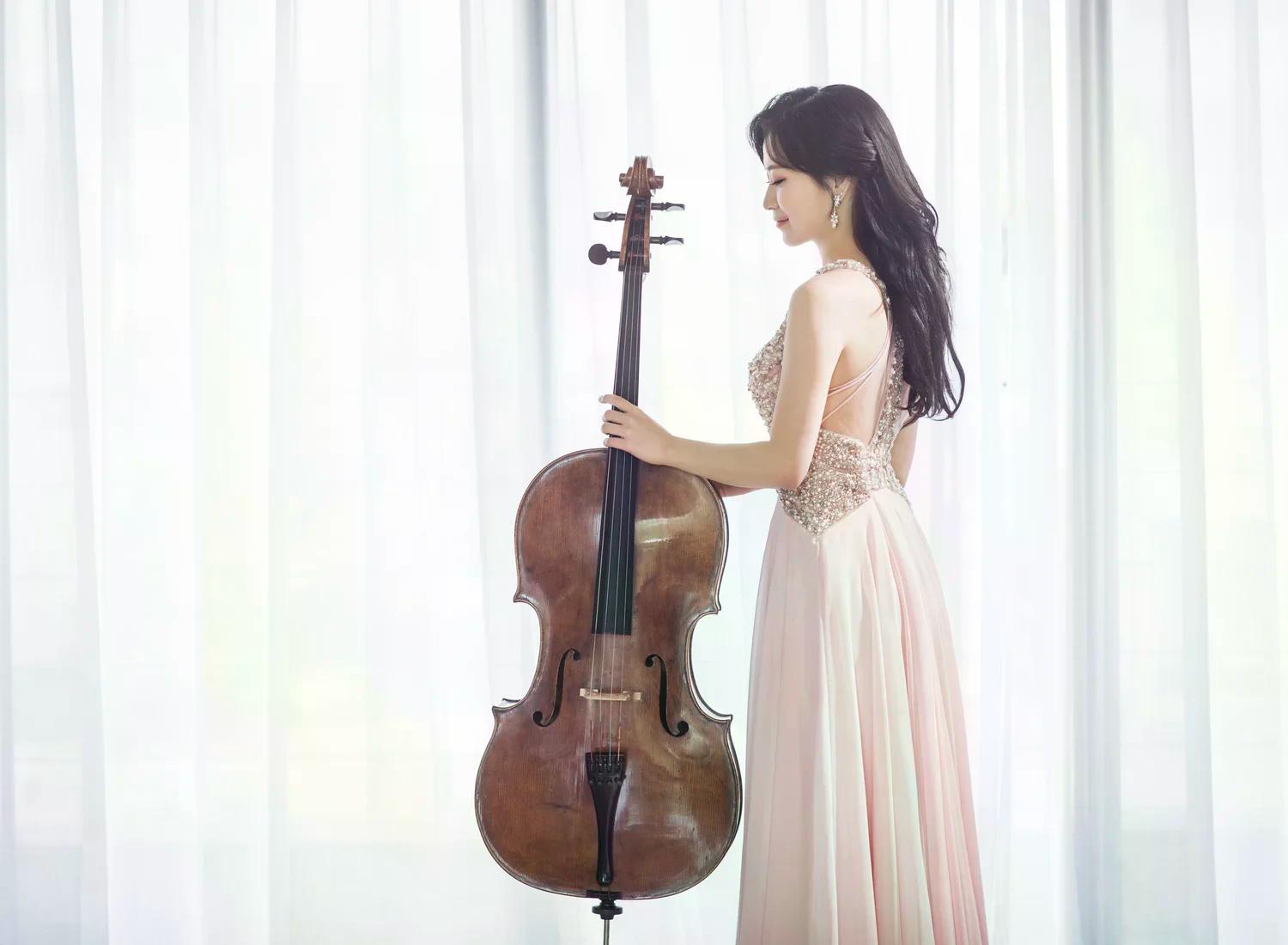
Lee is currently preparing a major research project and a complete recording of Emilie Mayer’s cello sonatas. Not only did she bring with her an immense knowledge of Mayer, editorial acumen, and virtuoso cello skills, she also conjured up at our first meeting a visionary cover design, depicting how a Henle edition of Mayer’s cello sonatas might appear. While Henle’s set-in-stone design guidelines for covers necessitated a few changes, this cover – confidently projected onto the wall in vibrant blue – sealed Mayer’s arrival at the Henle publishing house. Mayer wrote twelve cello sonatas (one of them titled “Duet” rather than “Sonata”). Together with Seonhwa Lee, we quickly agreed to make available in Henle Urtext edition the three sonatas selected by the composer herself for publication by the Berlin-based publisher Bote & Bock.
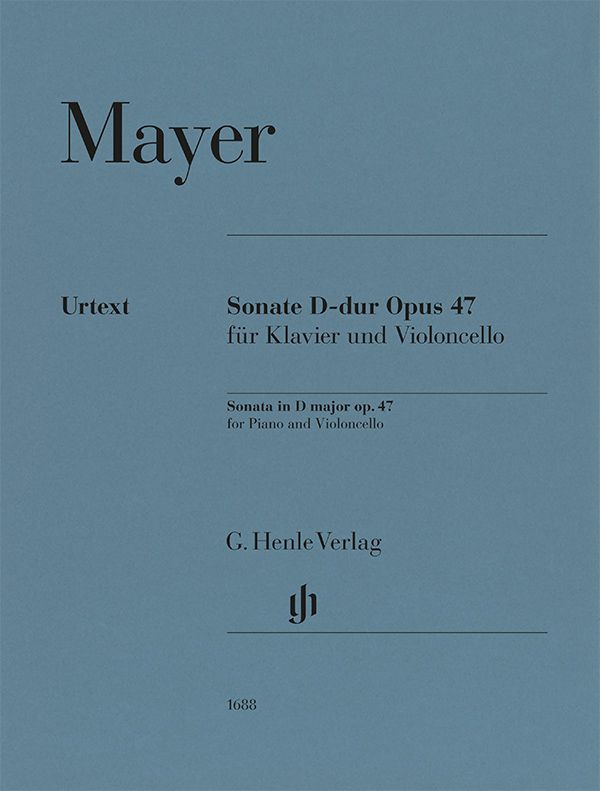
Henle’s first release, fresh off the press, with publisher’s number HN 1688, is the four-movement Sonata in D major, op. 47. Anyone who places this edition on the music stand gets the full package from Seonhwa Lee: a historically-contextualising preface, a meticulously-researched Urtext edition with critical apparatus, and modern, practical markings for the solo part. The piano fingering was contributed by Lee’s duo partner, Nicholas Rimmer. Modern notation, thoughtfully designed page turns, and fold-out tables in the solo parts round out a wonderful, Henle-quality package.
This sonata is a special work, both biographically and in terms of its sources. It marks the culmination of a remarkable compositional career. The sonata was presumably first performed just one month before Mayer’s death on 10 April 1883. Included in that month’s issue of the Neue Berliner Musikzeitung, in which the sonata was announced as “just published”, was also an obituary for the recently-deceased composer.
In its source situation, this sonata differs from all of Emilie Mayer’s other cello sonatas. Only with this sonata can we draw upon a wealth of sources, as we have both a “genuine” first edition, personally authorised by Mayer, complete with a separate solo part, and two autograph manuscripts. This is an editorial luxury. But it also presents a challenge: One autograph contains only the solo part and can be identified as the engraver’s model for the first edition’s separate cello part. Present here is a high degree of agreement between the sources regarding the music text. The autograph score reveals, however, an earlier stage in the sonata’s composition. Its analysis thus required a delicate touch, offering, on the one hand, important clues in many cases for identifying and correcting errors in the first edition, but necessitating, on the other hand, careful attention so that the sonata does not regress to an earlier development stage. A fascinating task, which Seonhwa Lee and I, as supervising editor, tackled through lively conversation.
It was well worth the effort, for with Emilie Mayer’s Cello Sonata, op. 47, now available in scholarly Urtext, we hope this composition will soon expand the standard repertoire. Mayer’s full compositional maturity is evident in this sonata. A slow introduction, notated without key signature, sets the stage for the first movement’s blossoming D-major main theme (Allegro con spirito). The solo part is beautifully lyrical, and the supple, at times virtuosic, piano accompaniment reveals the outstanding pianist that Mayer herself was. The solo cello and accompanying piano parts are closely intertwined thematically, creating a highly dialogic character.
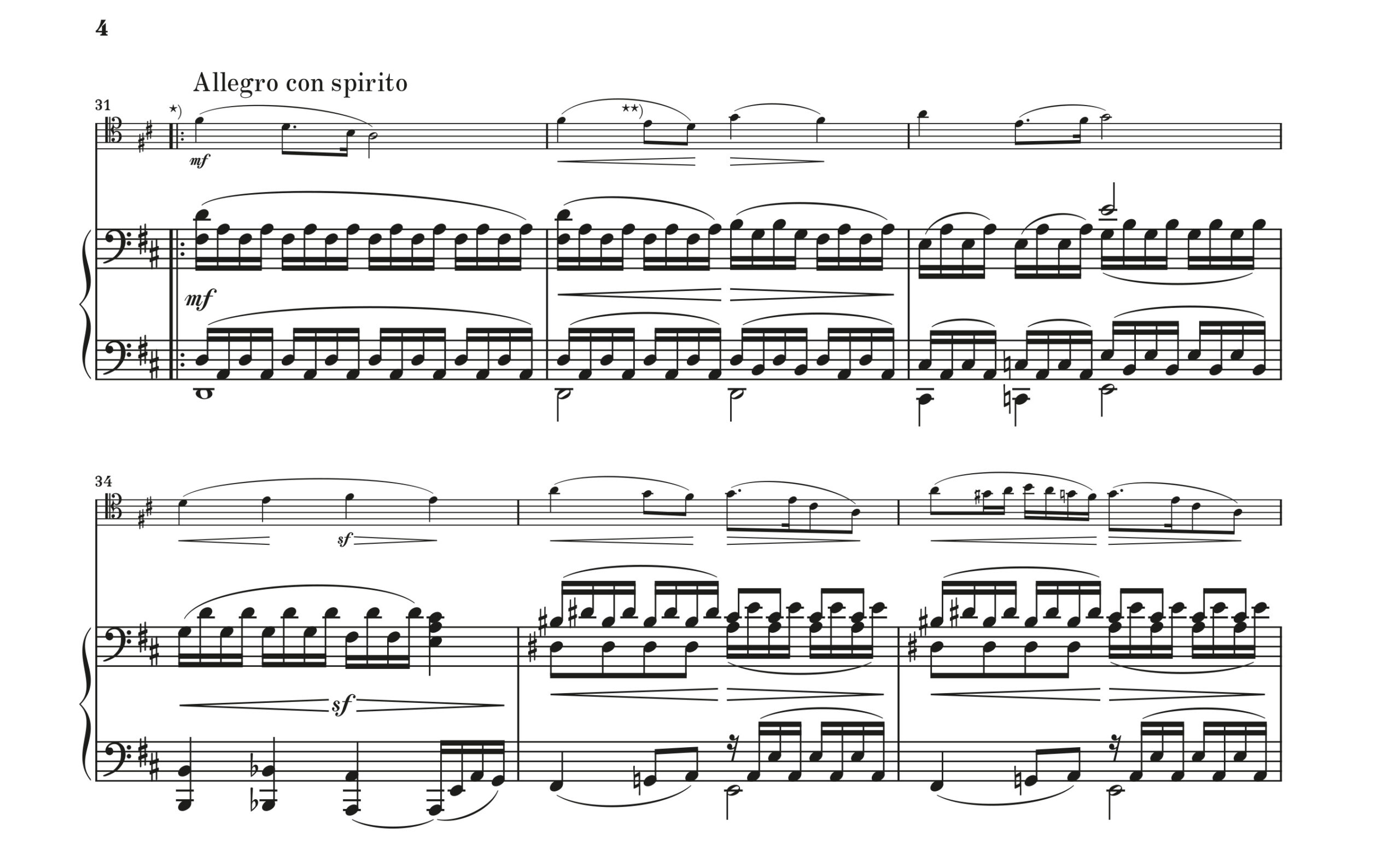
1st movement, main-theme entry, Henle-Urtext
Such a dialogue also characterises the following Scherzo. Mayer has given it a robust and spirited air. The piano opens the conversation and often propels the movement forward with a concise pulse. Noteworthy are also the abrupt tempo changes, greatly enlivening the music.
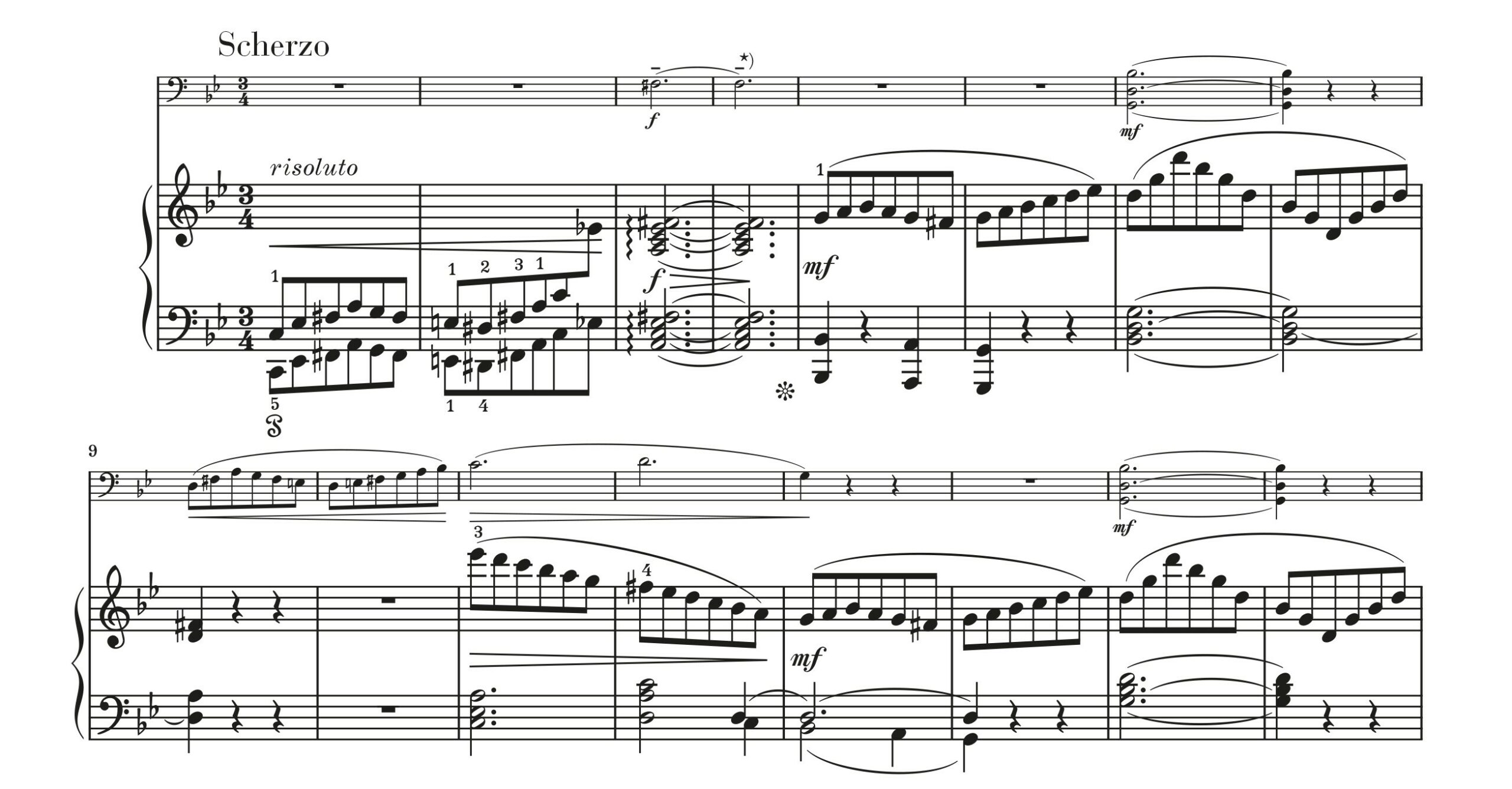
Energetically-driven piano part opening the Scherzo, Henle-Urtext
In the Adagio, too, the piano begins alone – with an eight-measure introduction of chordal tranquillity almost resembling the prelude to a lied. The cello part then enters in a beautifully lyrical style (cantabile).
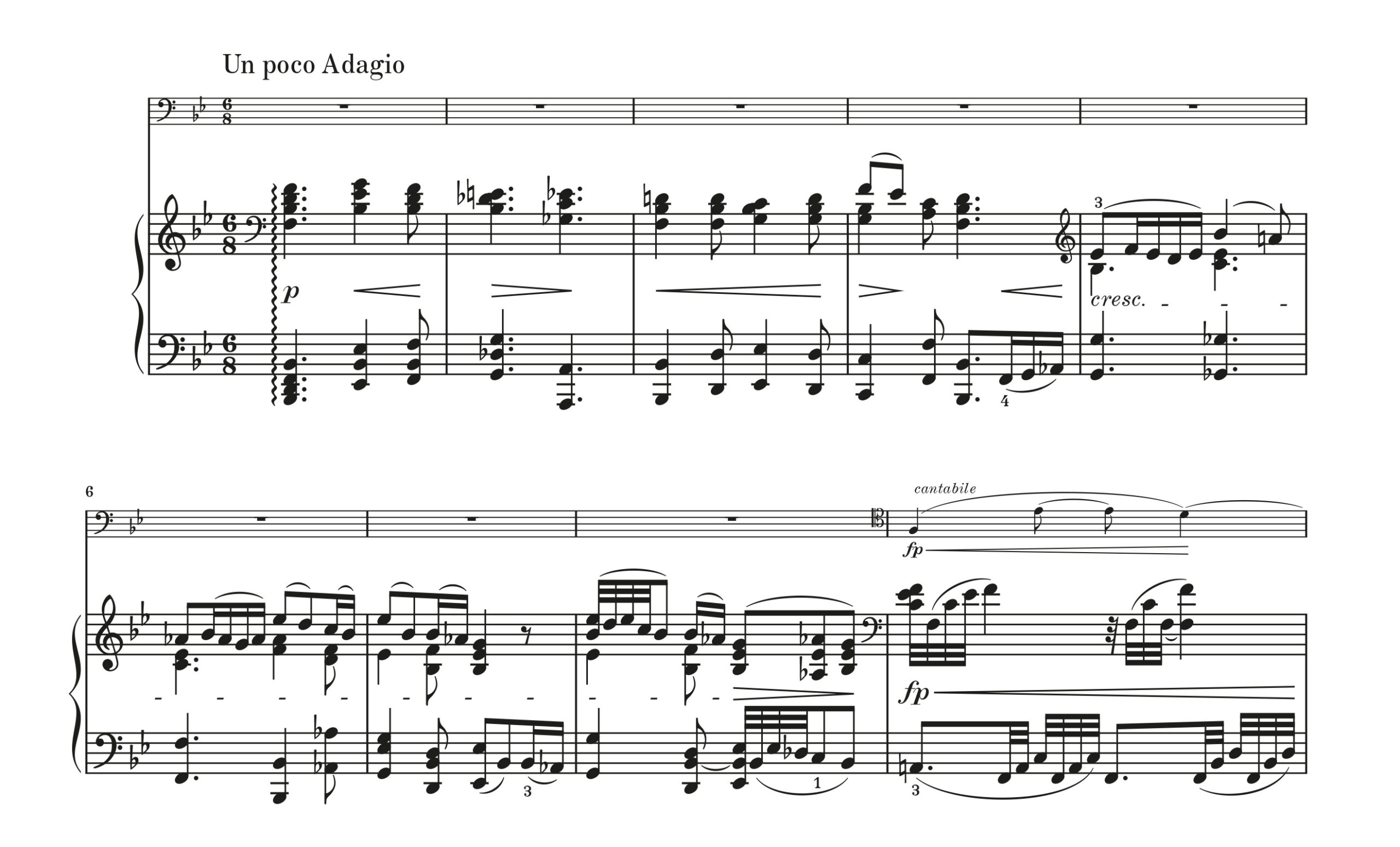
Prelude to the Adagio, Henle-Urtext
The Allegro finale is ultimately a playful celebration in radiant D major with figuratively animated, richly ornamented parts. Seonhwa Lee particularly appreciates that even here, at a rapid pace, Mayer maintains the lyrical, melodic approach of her music and masterfully incorporates it within the music dramaturgy – “especially where a recitative appears towards the end. For me, this is a passage where Mayer’s personal style really comes to the fore,” says Lee.
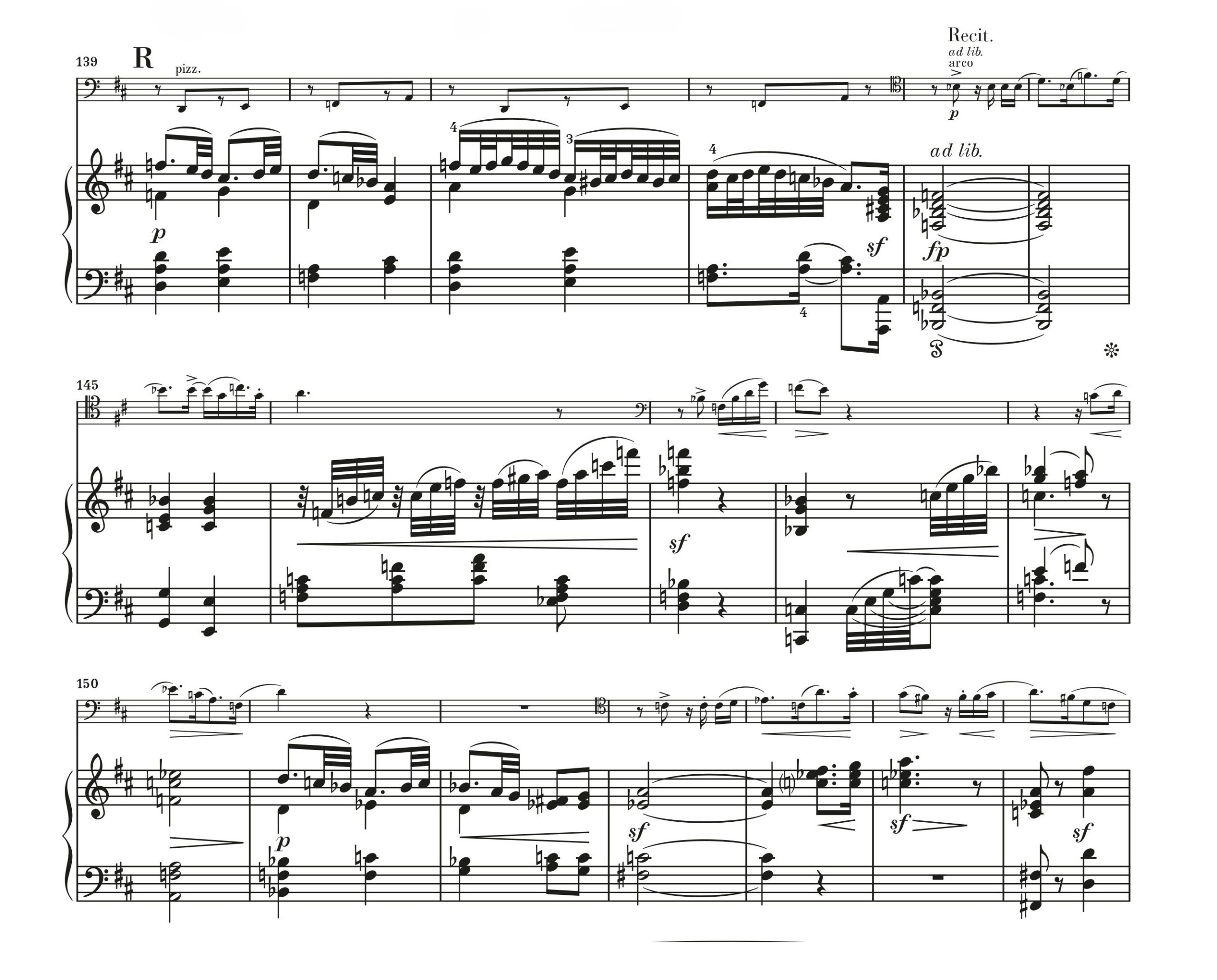
”Rezitativo” in the fourth movement, mm. 143–156, Henle-Urtext
Recordings of this wonderful sonata are still hard to find.
The modern Urtext edition now available will soon help to change that significantly, as Seonhwa Lee is currently recording the work, based on her edition, to be released by Hänssler Classic in 2027, together with the other Mayer cello sonatas.