
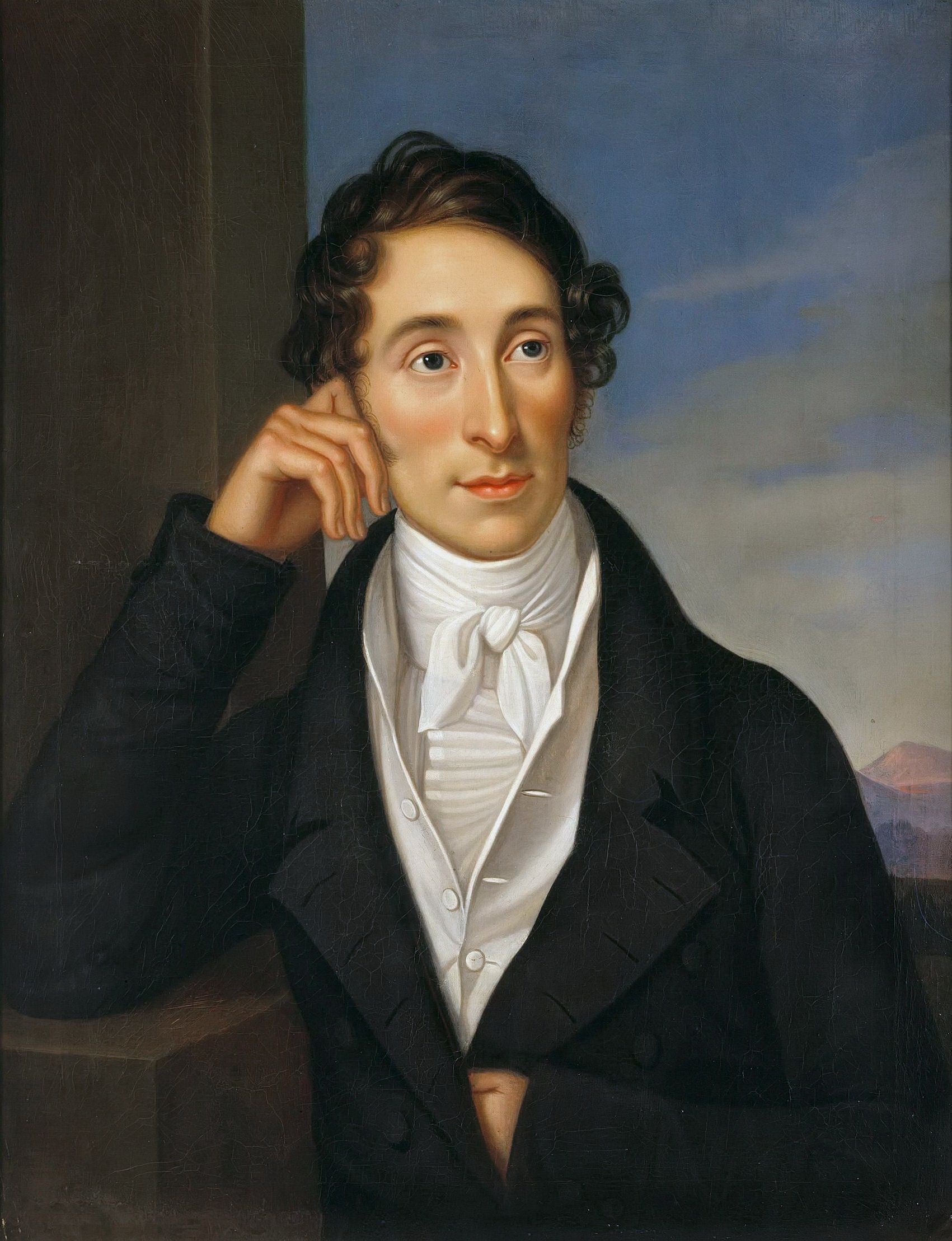
 Just a few days ago we marked the 200th anniversary of Carl Maria von Weber’s death at only age 39, in London during the night of 4–5 June 1826. G. Henle publishers is honouring the great Romantic composer with an Urtext edition of his beautiful bassoon concerto, fitting perfectly within our growing catalogue of Weber’s works.
Carl Maria von Weber is best known today as the composer of Der Freischütz and the founder of German Romantic opera, though he also created in the instrumental genres numerous captivating works that are still encountered in concert halls and on musicians’ music stands worldwide.
Thus, the Henle catalogue also offers a diverse selection of his chamber music and concertos in reliable Urtext editions. Pianists can have a go at the virtuosic f minor Concert Piece for Piano and Orchestra, op. 79 (HN 829), or at the no less demanding piano works (HN 414), standing out amongst which is particularly the waltz-rondo Invitation to the Dance, op. 65 (HN 415). Alongside these are selected chamber pieces such as the Trio in g minor for Piano, Flute, and Cello, op. 63 (HN 687), or – insider’s tip – the moderately difficult six Violin Sonatas, op. 10 (HN 182), ideally suited for students.
Weber is especially popular amongst wind players, to whom he dedicated a series of magnificent solo concertos. For clarinetists, in particular, the two major concertos in f minor (HN 731) and E-flat major (HN 732), respectively, as well as the Concertino in E-flat major (HN 718), have become central highlights of their solo repertoire. Horn players were delighted by Weber’s technically demanding Concertino in e minor, op. 45 (HN 1179), requiring, amongst other things, simultaneously blowing and singing into the instrument.
 Finally, for the bassoon, Weber’s Concerto in F major, op. 75 – along with Mozart’s bassoon concerto – represents the undisputed pinnacle of the Classical-Romantic repertoire, a work that no aspiring bassoonist can ignore, whether in their studies, competitions, or auditions for orchestral positions.
Our new Urtext edition of Weber’s bassoon concerto (in piano reduction), HN 1690, has just rolled off the printing press and will soon be on the market. How is it different in comparison with previous editions of the concerto?
Whilst preparing my edition, I had to find out that commercially available is, indeed, only one reliable and faithful edition of the bassoon concerto, published in 1990 by the bassoonist and musicologist William Waterhouse. (The corresponding volume has yet to appear within the Weber Complete Edition.) Waterhouse compared the authentic sources available to him – Weber’s 1822 autograph and the first edition of 1824 – with all subsequent editions and found the latter heavily edited and consistently including extraneous additions (his insightful 1986 essay – in German – on the preparation of his edition can be viewed here, online).
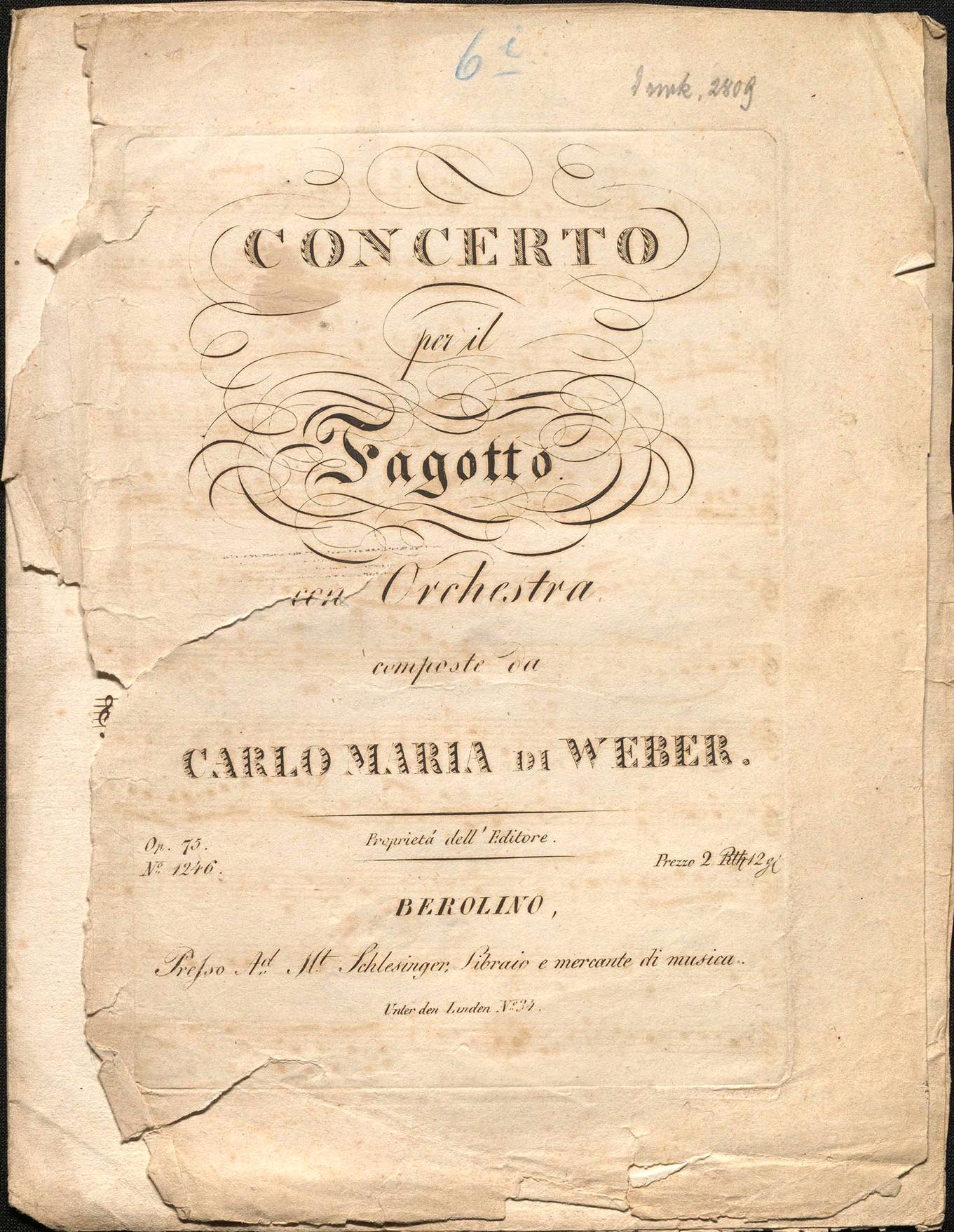
First edition, M.A. Schlesinger, Berlin, 1824, title page;
Badische Landesbibliothek, shelfmark DonMusDr 2809
As I quickly discovered from my own source comparisons, the root of all the problems lay in the fact that the first edition, commissioned and authorised by Weber himself and published by M. A. Schlesinger, consisted, as was customary at the time, solely of individual parts (i.e., bassoon solo and orchestral parts), but included neither a full score nor a piano reduction. Because a piano reduction ultimately became indispensable for the concerto’s practical rehearsal and wider dissemination, the publisher Schlesinger (by then succeeded by R. Lienau) provided such – but not until 1870, over 40 years after Weber’s death! For this piano reduction, the bassoon part was also re-engraved and heavily edited by an unknown editor – a small impression of its extent is given by this comparison of the slow middle movement (click on image to enlarge):
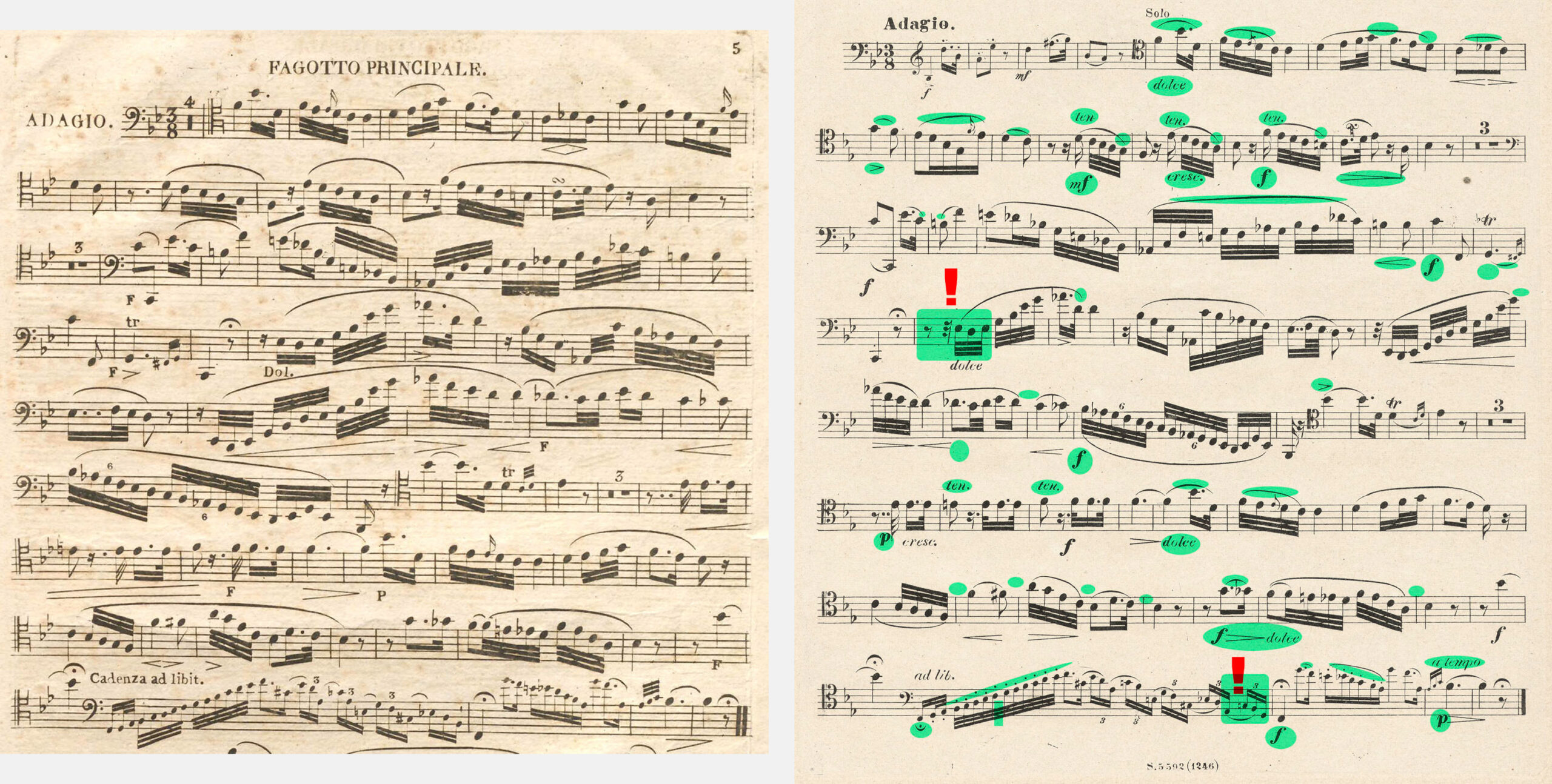
left: first edition, M.A. Schlesinger, Berlin, 1824, solo part, p. 5
right: new edition, M.A. Schlesinger/R. Lienau, Berlin, 1870, solo part, p. 5
The numerous added slurs are the least of the problems here; one would hardly play the lyrical cantilena staccato. More problematic are the additional dynamic markings, encroaching upon one’s personal and individual musical interpretation of the Adagio. Truly appalling, however, are both the rhythmic alteration in m. 29 and the freely added triplet at the end of m. 60, interfering with the composition’s very substance.
Disastrously, since this new bassoon part from 1870, full of inauthentic additions and notational changes, became the model for all subsequent new editions by other, 20th-century publishers, these incorrect readings became firmly established as the standard. No one presumably later suspected that the edition published by Weber’s original publisher, Schlesinger/Lienau, had by then strayed significantly from the original….
Waterhouse’s commendable edition was the first to return to the original readings of the autograph. The editor was, however, unaware of a very important source: namely, a full-score copy that in late summer 1822 Weber had made from his autograph for the Schlesinger publishing house to use as a clean and legible engraver’s model. In this copy, though, Weber subsequently added further compositional changes not appearing in the autograph! These additions can be clearly recognised as in Weber’s characteristic handwriting and are also in darker ink. Examples include the legato slur in the first movement, mm. 94–96, and the indication brillante in m. 97.
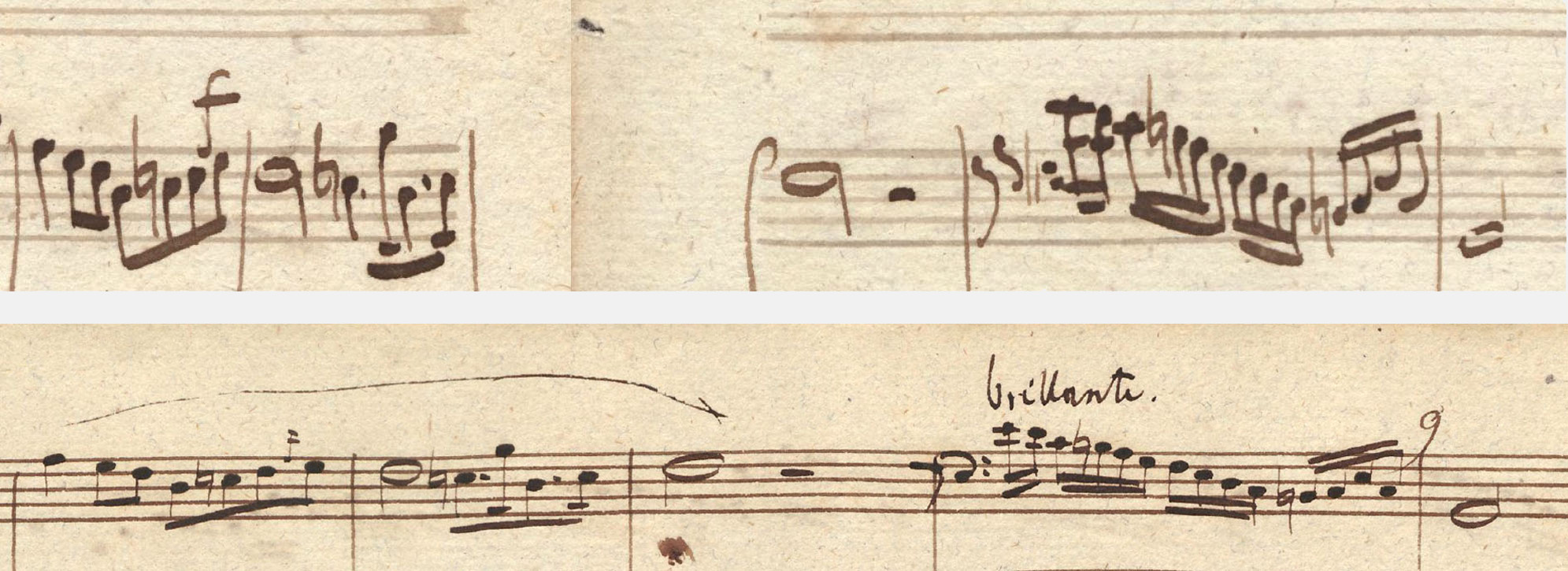
top: autograph full score, Staatsbibliothek zu Berlin · Preußischer Kulturbesitz,
shelfmark Mus. ms. autogr. C. M. v. Weber WFN 14 (1), p. 8/9, mm. 94–98
bottom: full-score copy, Staatsbibliothek zu Berlin · Preußischer Kulturbesitz,
shelfmark Mus. ms. 22756, p. 14, mm. 94–98
The publishing house consequently included these details in the first edition:

First edition, M.A. Schlesinger, Berlin, 1824, solo part, p. 2, mm. 94–97
The engraver’s model, full-score copy is therefore an extremely helpful source: it allows us, in countless cases, to clarify definitively whether a difference between the autograph and the first edition can be attributed to Weber or was, perhaps, an engraver’s oversight (always, of course, also a frequent possibility). Waterhouse’s edition, on the other hand, follows the outdated readings of the autograph in many details, as is the case here with an accidental added later by Weber in the 2nd movement, m. 27:
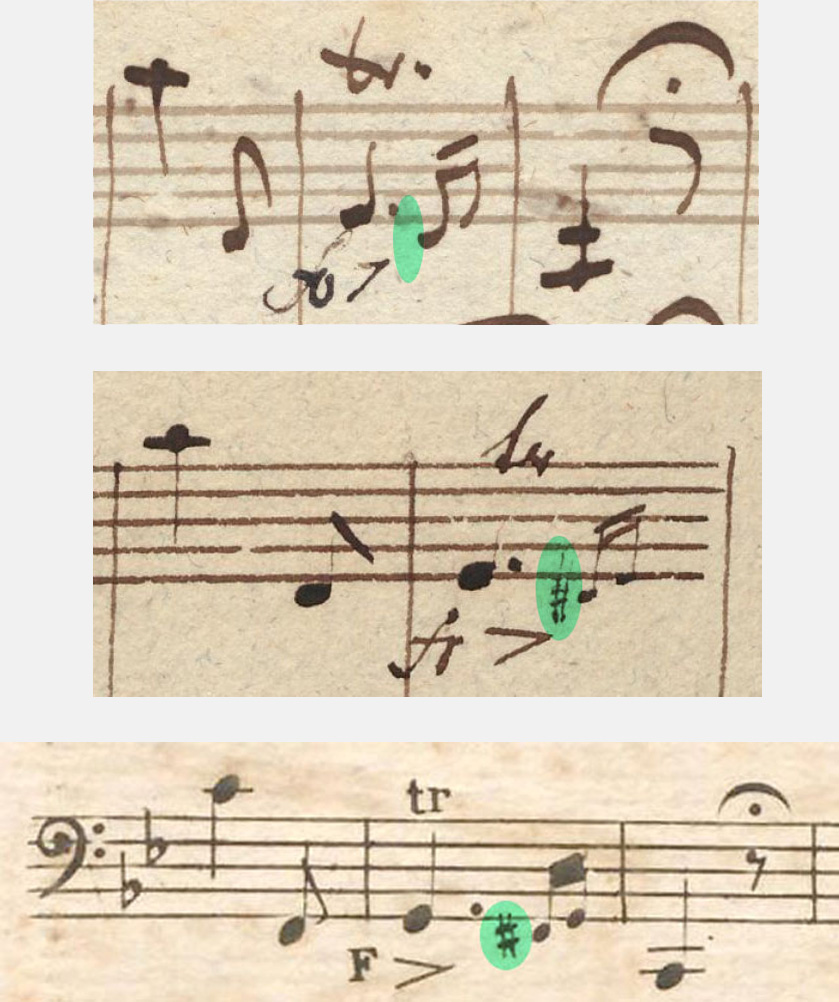
top: autograph score, p. 26, mm. 26–28
middle: full-score copy, p. 41, mm. 26–27
bottom: first edition, solo part, p. 5, mm. 26–28
With the Henle Urtext edition, a critical edition of Weber’s bassoon concerto is now available for the first time, evaluating all three relevant sources (autograph, engraver’s model, and first edition). It reproduces the music text Weber ultimately intended as accurately as possible and also provides detailed information on variant readings and problems. And although the corrupted 1870 bassoon part naturally played no role in our edition, we nevertheless document its most serious distortions in our Critical Report, precisely because they had such a devastating impact on later reception. Two hundred two years after the first edition was published, it is high time to restore Weber’s bassoon concerto to its true form.